Vana or Vespera Wallet on Qualifying Orders Over $500

Best default: a closed-back kitten-heel pump that passes your standing-and-walking fit test. Best for lighter visual coverage: a secure slingback. Best for a pitch followed by dinner: a restrained embellished pump. Choose kitten heels for boardroom meetings by fit, floor contact and outfit proportion, not by the promise that a lower heel automatically makes a shoe comfortable.
A board presentation asks something different from a seated lunch. You enter, wait, stand, turn towards a screen and move between conversations. The shoe needs to work through those transitions, not merely look convincing beneath the table.
For your 2026 meeting wardrobe, start with the occasion you actually have. A confidential investor discussion, a formal committee presentation and a creative-sector pitch need not share the same styling answer. The common requirement is footwear that does not demand repeated adjustment.
HOPE ROZA’s Performance Luxury approach suits women choosing occasion footwear by physical experience as well as appearance. That principle gives you a useful buying question: what does this shoe let you do, and what does it ask you to tolerate? Explore HOPE ROZA with that distinction in mind.
A shoe should not need more preparation than the presentation.
Judge these criteria before choosing a silhouette. A favourable result on one does not cancel a failure on another.
These are selection criteria, not a claim that every pump beats every slingback. Fit can reverse the recommendation. Your own standing-and-walking assessment remains essential even when a product has published testing.
This comparison ranks shoe formats by their role in a meeting wardrobe. It does not rank individual products or present a wear trial.
| Shoe format | Best for | Useful design distinction | Key limitation |
|---|---|---|---|
| Closed-back kitten-heel pump | A first pair for formal presentations | Closed rear coverage gives you a clear heel-fit checkpoint | A closed back still fails if it slips or rubs |
| Kitten-heel slingback | Lighter tailoring and less visual coverage | An open back changes the outfit’s finishing line | Strap position and retention require careful assessment |
| Restrained embellished kitten-heel pump | A pitch followed by a meaningful evening occasion | Ornament introduces an intentional focal point | Decoration can compete with other outfit details |
The default is a starting point, not permission to ignore fit. If the closed-back pump fails and the slingback stays secure, choose the slingback. The purpose of comparison is to improve your decision, not defend a ranking.
A closed-back pump gives a tailored outfit a contained finishing line. It suits the woman who wants the footwear decision settled before a formal presentation, without adding another prominent design element.
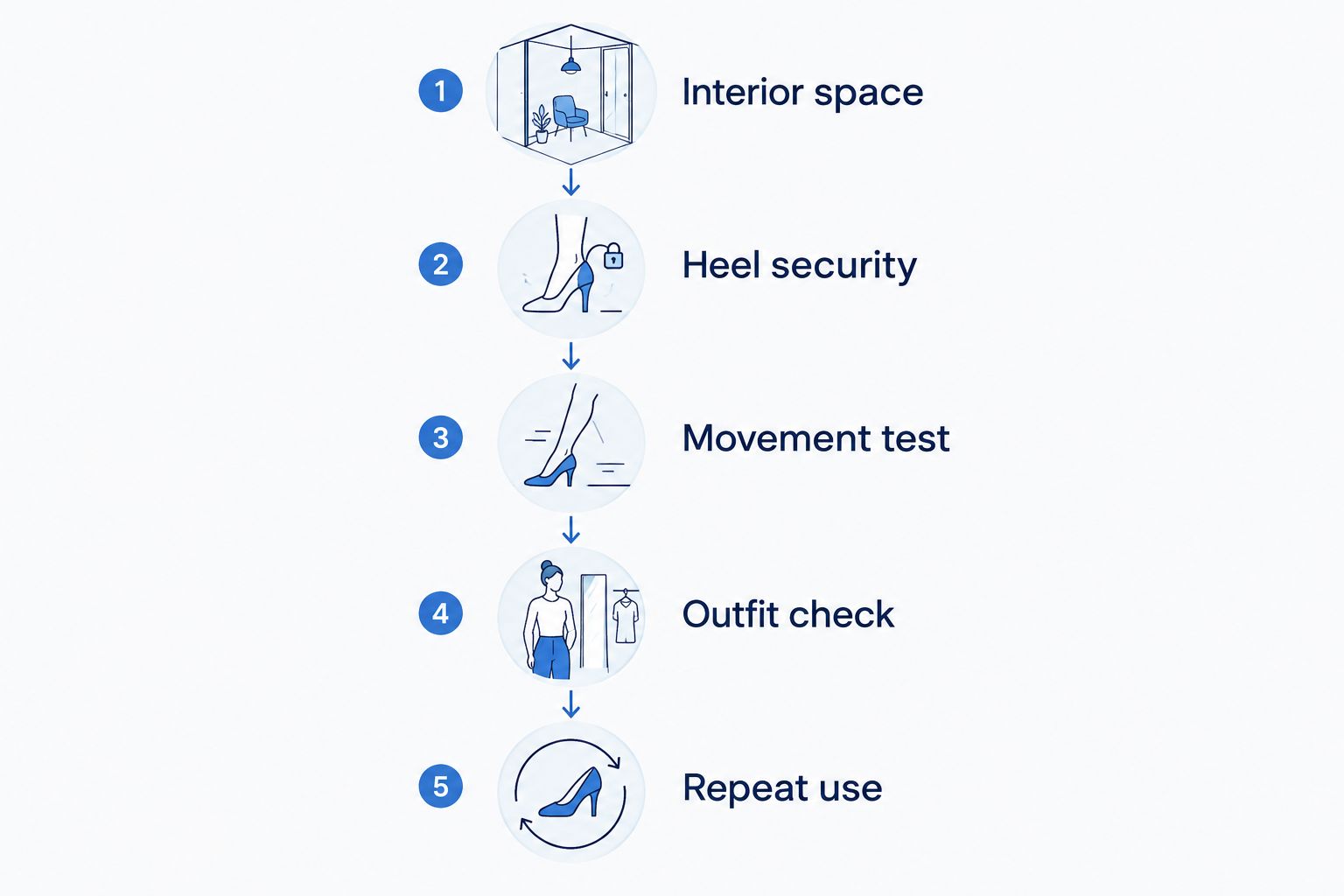
Assess the rear fit while walking, not just while seated. Look for heel movement, pressure at the edge and any need to alter your stride to keep the shoe on. Closed coverage is a construction feature, not proof of security.
Best for: Formal presentations where you prefer a contained silhouette and minimal visual interruption.
For a 2026 boardroom wardrobe, try the pump with your actual presentation outfit. A trouser hem that works with another shoe can sit differently here. Check the hem while walking and sitting, then inspect the complete outfit from a normal viewing distance.
Verdict: Choose the closed-back pump as your default only after it passes the fit test. Skip the pair that needs you to manage it.
A slingback leaves the rear of the foot visually open while retaining a strap. That distinction can suit a less enclosed outfit composition, particularly when you want a tailored dress or cropped trouser to finish with less coverage.
The strap is the deciding feature. Assess whether it stays positioned during walking and turns, and whether its edges press or rub. Do not assume that adjustability, when present, can correct a shoe whose overall shape does not suit your foot.
Best for: Lighter tailoring when you prefer less rear coverage and the strap remains secure.
Try the slingback with the outfit’s strongest detail in mind. If the jacket has an architectural cut, let the shoe remain quieter. If the clothing is deliberately simple, a more distinctive shoe shape can carry the finishing role.
The useful question is not whether slingbacks belong in offices as a universal rule. It is whether this pair suits your host, setting, outfit and movement requirements.
Verdict: Choose the slingback for its proportion and verified fit. Skip it if the strap becomes a recurring task.
An embellished pump puts a deliberate detail at the end of the outfit. It can give simple tailoring a second register for a leadership dinner, gallery opening or celebration after the meeting.
Restraint is about the whole composition, not a ban on decoration. A crystal detail can sit comfortably beside plain tailoring; several competing focal points require a more deliberate edit. Treat that as styling judgment, not a scientific rule.
Best for: A work-to-dinner plan where the same outfit must answer both invitations.
Before adding an embellished pair to your 2026 wardrobe, check it against 2 complete outfits you already own. Use the actual garments, rather than imagined future purchases. The exercise tests whether the shoe resolves a real wardrobe gap or creates a new shopping list.
Verdict: Choose the embellished pump when its detail earns repeat use. Wait if you need an entirely new outfit to justify it.
The closed-back pump comes first because it is the clearest starting format for a contained formal silhouette. The slingback answers a different proportion brief; the embellished pump answers a work-to-evening brief. Neither is automatically inferior.
The order follows occasion relevance, outfit versatility and the fit checkpoints each construction requires. It does not establish comparative comfort, durability or performance results for unnamed products.
Keep your fitting process consistent. Compare shoes with the hosiery, garments and movement you expect, rather than changing the conditions between pairs.
A familiar shoe that passes these checks is a more useful presentation choice than an unassessed pair selected for novelty. Do not make an important pitch the first occasion on which you discover how a shoe behaves.
Performance Luxury is the union of fashion design, sport-science principles, engineering, measurable wearability, material intelligence and luxury expression. The useful distinction is attention to how the product performs for the woman wearing it, not only how it looks.
HOPE ROZA’s Air Vault™ is its patent-pending triple-layer sole architecture for refined heels. It is engineered to manage impact, return energy, distribute pressure and reduce loading beneath the forefoot while preserving a slim luxury profile. These are design intentions, not a medical promise or a universal comfortable-wear duration.
For a standing-intensive presentation in 2026, distinguish three questions: does the shoe fit you, what construction does it use, and what product-specific testing supports its claims? None replaces the others. Sole architecture cannot excuse an upper that compresses or a heel that slips.
Where a listing provides Hours of Wear, read it as the product-specific number of hours assessed as comfortable in HOPE ROZA sample wearer testing. Check the testing context and limitations. Do not treat another wearer’s result as a guarantee for your own meeting.
Choose the closed-back pump first if you want a restrained presentation shoe. Move to the slingback when its lighter coverage suits the outfit and its strap passes your movement check. Choose restrained embellishment when the evening invitation is genuinely part of the brief.
The right 2026 purchase should answer more than the next calendar entry. Consider fit, condition, relevant repeat use and the care or repair information supplied for the actual pair. Repeated use is a value question; it is not, by itself, proof of an environmental benefit.
The wardrobe has enough applicants. Give the job to the shoe that meets the brief.
Should I buy a new pair of kitten heels for an investor pitch?
Buy a new pair only if your existing footwear does not meet the occasion, fit or condition brief. A familiar, well-maintained pair that stays secure is a sensible presentation choice.
Can I wear embellished kitten heels to a conservative meeting?
Use the host’s conventions and your complete outfit to decide. A restrained ornament with plain tailoring is a different styling proposition from several competing decorative details.
Does a pointed-looking pump automatically lack toe space?
No. Assess interior length, forefoot width, upper cut and seam placement rather than judging fit from the exterior outline alone. The standing-and-walking test determines whether the actual shoe suits you.
Should I size up if a kitten-heel pump feels tight?
Do not assume a larger size fixes the problem. Reassess interior space and heel security together, because extra length can introduce slipping without resolving the source of pressure.
Do my shoes and handbag need to match exactly for a board meeting?
No. Coordinate their formality, visual weight and relationship to the outfit rather than requiring an identical colour. Use your complete outfit as the reference.
What should I do if heels cause persistent pain or numbness?
Stop wearing the shoes and seek medical advice for persistent pain, swelling, numbness, skin breakdown or walking difficulty. A shopping guide cannot diagnose the cause or recommend treatment.
Before buying another pair, inspect the one you already reach for. Assess its fit, visible condition and suitability for the room, then seek an appropriate repair assessment where needed. Replacement should solve a problem, not merely restart the search.
Dress Like It Matters. Choose footwear that lets your attention remain with the people, the argument and the occasion.
Betty James — Stylist


