Vana or Vespera Wallet on Qualifying Orders Over $500

You can tell if a small leather good is well stitched by checking consistent stitch spacing, balanced thread tension, secure seam endings, and intact leather around the needle holes. Inspect the inside as carefully as the outside, then open and close the piece without forcing it. For a 2026 purchase, judge how the seam behaves, not simply how decorative it looks.
Betty James — Stylist
A wallet comes out at a leadership dinner. A cardholder moves between a work bag and an occasion clutch. Those repeated movements make construction relevant long after the first admiring look.
Stitching deserves attention because it joins components that must move together. A tidy line is useful evidence of care, but it does not establish the quality of the leather, the strength of hidden construction, or the life of the finished piece.
HOPE ROZA approaches this through Performance Luxury: consider how an accessory performs for the woman using it, not only how it photographs. Assess the whole seam, not its most flattering centimetre. A monogram is not a structural engineer.
Use this inspection sequence for a wallet, cardholder, or small leather clutch. Work in good light, handle the piece gently, and distinguish visible evidence from information you still need from the maker.
Follow the seam from its beginning to its end rather than examining one straight section. Look for a deliberate route that follows the component’s shape, with a consistent relationship between the stitch line and the leather edge.
Pay attention to corners and transitions. A maker must accommodate a change of direction, so the last stitch before a corner need not look identical to every stitch on a straight run. What matters is an orderly transition rather than a wandering line, a missed hole, or an abrupt cluster of overlapping stitches.
Compare equivalent sections of the same item. That is more useful than imposing one visual style on every leather accessory.
Look for a regular rhythm between needle holes along comparable stretches of the seam. Sudden long gaps, accidental-looking short stitches, or skipped sections deserve a closer look.
Do not confuse close spacing with quality. Stitch length has to suit the leather, thread, seam, and construction method. A densely stitched line is not automatically stronger, and a more widely spaced line is not automatically poorly made.
Ask whether the spacing is controlled and appropriate, not whether it is the smallest you have seen. There is no universal stitch count that proves a wallet is well constructed.
Thread should sit neatly against the surface without hanging in loose loops or visibly gathering the leather. Look along the seam at an angle; unevenness often becomes easier to see than it is in a straight-on photograph.
Puckering means the surface has gathered along the seam. It is a reason to investigate tension, material handling, and construction, rather than proof of one particular manufacturing mistake.
Inspect both faces where accessible. A clean exterior with loose loops underneath is not a balanced result. Do not pull on the thread to test it; you are evaluating an accessory, not conducting a destructive laboratory trial.
Find where the stitching starts and stops, especially around pocket openings and the ends of joined panels. Look for secure finishing without loose tails that are pulling out, unravelled sections, or an untidy mass of thread.
Different methods finish seams differently. Backstitching, secured thread ends, and concealed finishing can all be part of legitimate construction, so one visible technique is not compulsory.
The useful question is whether the ending looks controlled and remains intact during normal handling. If the finishing is hidden, ask how it is secured rather than guessing from the outside.
Look beyond the thread. Check for splits, tears, damaged edges, and holes that appear to be joining into an opening rather than remaining separate perforations.
Some holes are more visible because of the leather surface, thread contrast, or stitch-making method. Visibility alone is not a defect. Damage to the material around them is the more important distinction.
An edge coating can make an edge look tidy without showing every layer beneath it. Inspect the relationship between the seam and the edge, but do not scrape, peel, or bend the finish sharply to uncover construction.
Open and close a bifold naturally. Insert a card into a cardholder without overfilling it, or operate a clutch closure while watching the nearby seam.
Look for joined layers separating, stitching catching against the contents, or the seam pulling noticeably out of shape. Check that the item’s ordinary movement does not demand excessive force.
A brief handling check establishes only what you observed. It cannot prove long-term durability, water resistance, or repairability. A seam should support the intended movement without becoming the obstacle.
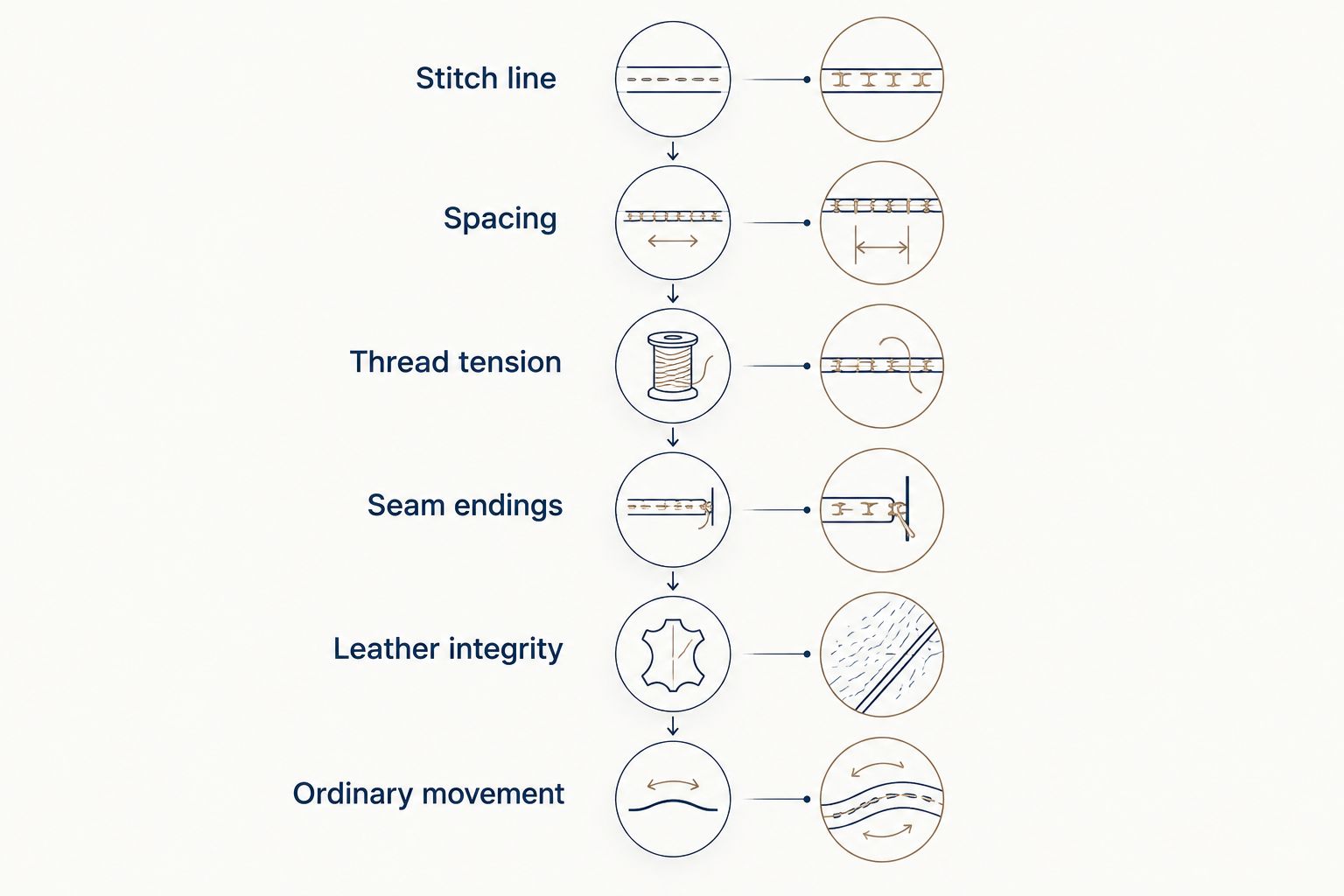
Use this table as a 2026 inspection framework, not a promise about product life. Each observation needs the context of the item’s construction and intended use.
| Check | Reassuring observation | Reason to investigate | Limit of the check |
|---|---|---|---|
| Stitch route | Controlled line following the component | Wandering line or missed section | Cannot reveal hidden assembly |
| Spacing | Regular rhythm on comparable sections | Abrupt gaps or accidental clusters | No universal ideal stitch count |
| Tension | Thread sits neatly; leather lies as intended | Loose loops or gathered leather | Photos cannot establish seam strength |
| Endings | Finishing stays intact under gentle handling | Pulling tails or unravelled stitches | Some finishing is concealed |
| Needle holes | Material remains intact around holes | Splits or tears connecting holes | Surface appearance varies by leather |
| Movement | Item opens and closes without seam distortion | Joined layers separate or thread catches | Brief handling is not a wear trial |
The inspection has a benefit and a limitation: it helps you identify visible construction concerns, but it does not replace technical information. A pristine seam can still sit beside a poorly functioning pocket or awkward closure.
Neither method guarantees a well-made small leather good. Judge execution, material compatibility, seam design, and finishing before giving either method extra credit.
For terminology, ISO 4915 classifies stitch types. A machine lockstitch and a hand saddle stitch are different thread constructions, even when their visible lines look similar. The standard describes stitch formation; it is not a luxury-quality ranking.
| Construction method | Best for evaluating | Useful characteristic | Limitation |
|---|---|---|---|
| Hand saddle stitching | A specifically described hand-sewn seam | Threads pass through prepared holes from opposite directions | Appearance alone does not verify the method or workmanship |
| Machine lockstitching | Consistently executed machine-sewn assembly | Needle and bobbin threads interlock | Poor tension or finishing can compromise the result |
Both methods still need suitable thread, sound leather, appropriate spacing, and secure endings. A slight variation in a hand-sewn line is not automatically a structural problem; a perfectly regular machine-sewn line is not proof of excellent hidden construction.
Ask the seller which seams use which method. “Handmade” can describe a wider production process without specifying how every seam was sewn.
A fair comparison accounts for the construction brief. These factors explain why two competent seams need not look identical:
Compare like with like. Do not use a decorative line on the front of a clutch as the sole evidence for the construction of its opening, lining, or closure attachment.
Neat quilting demonstrates control over the visible pattern, but it does not prove the quality of every structural seam. Inspect the perimeter, pocket openings, fold, and lining separately.
A quilted surface can be part of the design while another seam carries the work of holding components together. Ask which layers the quilting joins if that distinction affects your decision.
The stitch line should show a controlled relationship to the edge along comparable sections. Curves, corners, and changes in construction can require deliberate adjustments.
Look for coherence rather than mathematical sameness. An unexplained drift toward a damaged edge is more concerning than a planned change around a shaped corner.
For an online purchase in 2026, request useful views rather than more glamorous views. Ask for a close-up of a straight seam, a corner, the interior, and a seam ending. A short demonstration of the item opening and closing adds information that a static image cannot provide.
Check whether the photographs show the actual construction details you want to assess. Zooming into an already blurred picture produces larger uncertainty, not stronger evidence.
Ask specific questions:
Do not infer answers from a logo, a product name, or a broad craftsmanship claim. An unanswered construction question remains unanswered. Product photography has many talents; cross-examination is not one of them.
HOPE ROZA’s Performance Luxury approach suits women choosing accessories for consequential work and meaningful occasions. The relevant question here is whether construction supports access, security, organisation, and repeat use.
HOPE ROZA defines Performance Luxury as the union of fashion design, sport-science principles, engineering, measurable wearability, material intelligence, and luxury expression. For a small leather good, apply that philosophy to the functions the accessory actually performs, without importing footwear claims into a wallet.
A cardholder should let you retrieve the intended card without fighting its opening. A wallet should close with the contents it was designed to carry. A clutch needs construction that works with its closure and handling, not merely attractive stitching across its front.
For a considered 2026 purchase, evaluate appearance and operation together. Choose the piece whose construction supports your actual use, not the piece with the most elaborate craftsmanship vocabulary.
Before adding another accessory, inspect what you already own. If a seam has loosened but the leather and overall construction remain sound, ask a leather repair specialist whether restitching is practical. Repairability depends on access, existing holes, material condition, and the wider assembly.
Do not assume that a care product repairs a failed seam. Surface cleaning, conditioning, and structural repair are different tasks. Follow material-specific care instructions rather than treating every leather finish alike.
Pair this inspection with how to spot quality leather in a handbag. Stitching and leather condition belong in the same decision, even though neither proves the other.
HOPE ROZA’s fewer, better products philosophy makes repeat use part of value. It does not make neat stitching proof of sustainability, nor does it turn an expensive accessory into an automatically sensible purchase.
Can I tell stitch quality from a product photograph?
A clear photograph can reveal spacing, stitch routing, and some surface defects, but it cannot prove seam strength. Ask for interior views, seam-ending close-ups, and a demonstration of normal movement.
Does contrasting thread make stitching less durable?
Contrasting thread makes stitching more visible; colour contrast alone does not establish durability. Evaluate thread condition, tension, finishing, and the leather around the holes.
Is a loose thread always a reason to reject a wallet?
A loose thread needs investigation, but its appearance alone does not explain whether the seam is unravelling or an end was poorly trimmed. Ask the seller to clarify and correct it before accepting the item.
Can edge paint hide a poorly stitched seam?
Edge paint can obscure parts of the layered edge, but it does not establish whether the seam is sound. Inspect the visible stitching and request construction details without scraping the finish.
Should I stretch a seam to test its strength?
No, do not stretch a seam or pull its thread to test strength. Check the accessory through its intended opening, closing, and loading movements without forcing it.
What should I ask about leather stitching before buying in 2026?
For a 2026 purchase, ask about seam construction, finishing, interior views, and repair options. Specific answers help you assess the item more effectively than general craftsmanship language.
Does good stitching prove that a leather wallet is authentic?
Good stitching does not prove authenticity. Authenticity requires separate evidence about provenance and the item’s identity; workmanship inspection answers a different question.
Before deciding, find the least photographed part of the accessory: the inside of a pocket, the end of a seam, or the underside of a fold. Not because hidden construction must be decorative, but because it should still be resolved.
The useful luxury question is not whether the maker lavished attention on the part everyone sees. It is whether the less visible parts received the attention their job requires.
Dress Like It Matters.


