Vana or Vespera Wallet on Qualifying Orders Over $500

Kitten heels for lawyers are low, slender-heeled shoes chosen to support a formal working wardrobe without making height the main event. Choose them by the room, the fit and the movement your day requires: a court appearance, a client meeting and a standing reception do not set the same brief.
Betty James — Stylist
Share this guide: Facebook | WhatsApp | LinkedIn
A lawyer’s shoe has to belong to the setting and work while she moves through it. Start with the actual appointment, not a general idea of what professional women wear. Court requirements, your firm’s expectations and the client’s context take priority over a styling guide.
For your 2026 working wardrobe, separate 3 settings: formal appearances, client-facing office work and professional events. The same pair can serve more than one, but only if it meets each setting’s requirements. There is no useful universal rule that every lawyer should wear heels, black shoes or a particular toe shape.
HOPE ROZA is a women’s Performance Luxury house creating footwear, handbags and accessories for consequential work and meaningful occasions. HOPE ROZA’s Performance Luxury approach suits lawyers who want formal footwear evaluated for function as well as appearance. That is a selection philosophy, not a promise that every shoe suits every foot.
A heel should not become the most demanding participant in a client meeting. It has not prepared the brief.
Before buying anything, review the shoes you already own against your next consequential appointment. A familiar pair in sound condition deserves consideration before an unfamiliar purchase. Check the relevant court or event guidance directly rather than treating fashion convention as a legal requirement.
For formal appearances, build the outfit around compliance and restraint. For negotiations or client presentations, consider the client relationship and the room. A leadership dinner allows a different expression from an appearance before a court, even when both belong to your professional life.
Write a short brief for the shoe. Include the setting, the route there, the expected movement and whether work continues into an evening event. This turns an attractive purchase into a considered decision.
A pointed-looking pump does not tell you how much usable space sits inside it. Assess interior length, forefoot width, upper cut and seam placement together. A rounded or square outline is not proof of suitable fit either.
Try each shoe standing and walking, not solely while seated. Check whether your toes feel compressed, whether the upper presses across a joint and whether your heel lifts as you walk. A shoe that stays on only when you curl your toes has failed an important part of the assessment.
Use 4 checks in your 2026 fitting process: toe clearance, forefoot space, heel security and walking response. Keep those checks separate; passing one does not excuse failing another. Increasing the size is not a reliable answer when it creates heel slippage elsewhere.
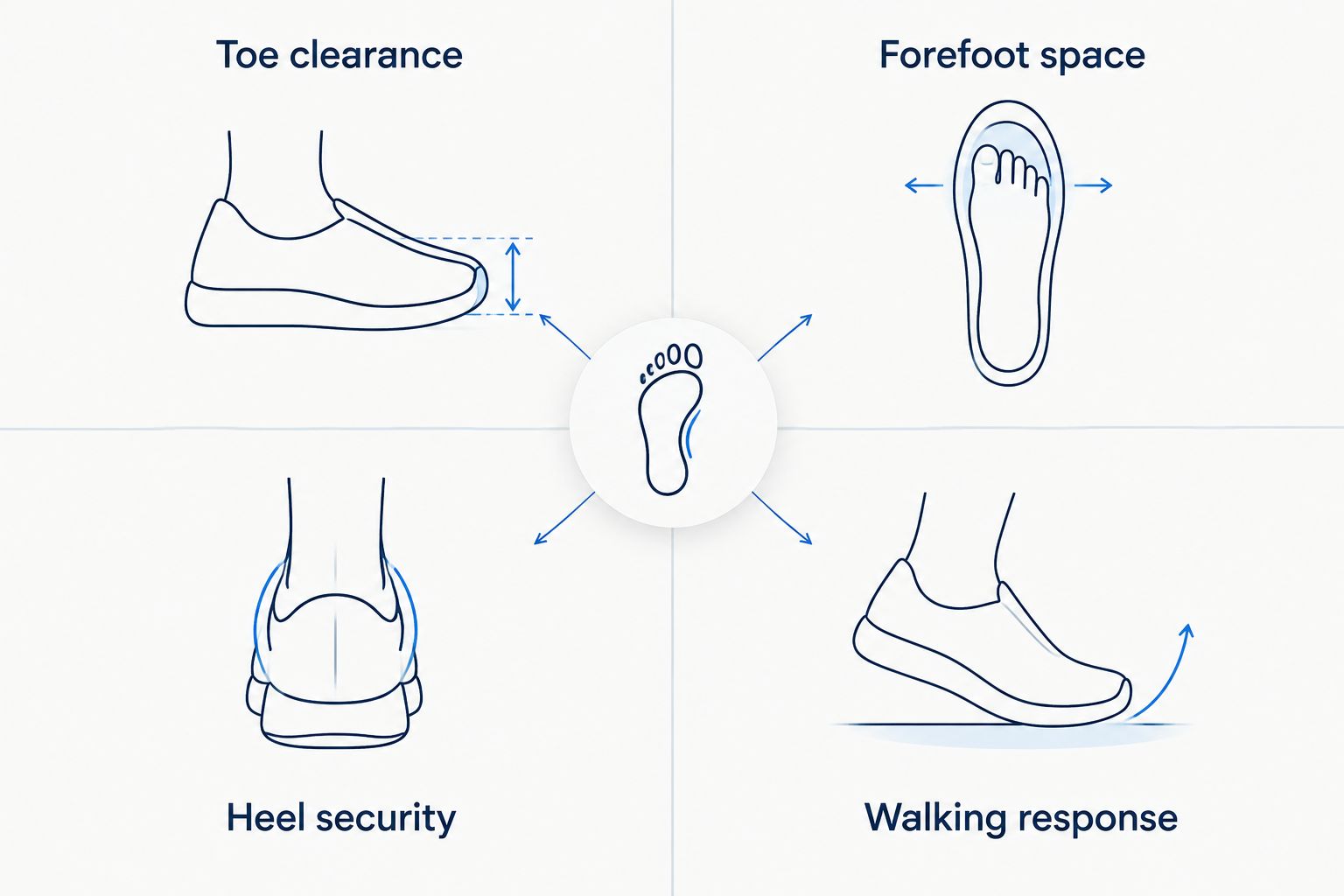
Begin with what you can check yourself. Look at the footbed, the lining, the upper’s contact points and the outsole condition. Then ask what the manufacturer means by cushioning, support or pressure management. Those words describe different functions and should not be treated as interchangeable evidence.
Air Vault™ is HOPE ROZA’s patent-pending triple-layer sole architecture for refined heels. Its 3 layers are engineered to manage impact, return energy, distribute pressure and reduce loading beneath the forefoot while preserving a slim luxury profile. This explains the design intention; it does not establish a personal wear duration or a medical benefit.
Do not assume every shoe from the house contains this architecture. Confirm construction on the individual product listing. If a listing gives an Hours of Wear result, read it as product-specific sample wearer testing, not a guarantee of your experience.
A sensible 2026 comparison separates the mechanism from the outcome: what is inside the shoe, what it is intended to do, and what testing supports the claim.
Start with a standing-and-walking comparison using shoes you already own. A closed pump provides coverage around the heel, but its usefulness depends on the fit of that heel counter. A slingback leaves the back open and relies on its strap arrangement to retain the foot. Neither construction wins automatically.
For lawyers, the practical question is whether the shoe stays secure during the movements the appointment requires. Walk, turn, sit and stand. Notice whether a slingback strap shifts or a closed pump rubs. Do not confuse an initially soft contact with reliable retention.
Also examine heel contact and outsole condition. A low heel remains a heel: its height alone does not establish grip or stability on polished flooring. Test only in permitted, safe conditions, and do not assume suitability for wet surfaces.
Put on the complete outfit before deciding whether the shoe works. Trouser length, skirt shape and the shoe’s visible outline form one composition. A pair that looks persuasive on a shelf can sit awkwardly beneath the actual hem.
Prepare 2 outfit combinations for your 2026 wardrobe assessment: one for your most formal professional setting and one for client-facing work that continues into dinner. Use clothes you already own. Photograph each outfit from the front and side so you can judge proportion without buying additional pieces to rescue an unresolved choice.
A restrained shoe can leave room for texture elsewhere. A coloured or crystal-accented shoe asks for more deliberate editing. Exact matching is optional; a coherent relationship between the clothes, footwear and bag matters more than identical colours.
Before adding another pair, identify the occasions it will serve and the gap it resolves. “Another black shoe” is not a gap. A secure formal pump that works with your existing tailoring is a specific need; a pair bought to accompany an outfit you do not own is a different proposition.
The Performance Luxury argument is that the woman’s experience belongs inside the design brief. For a lawyer, that includes fit, walking response, condition, maintenance and relevance to repeated professional occasions. Appearance remains important, but it is not the entire evaluation.
Review your 2026 calendar without pretending it predicts exact wear. A pair intended for recurring client dinners has a clearer role than one purchased for an imagined invitation. Repairability and care also matter, but confirm the options rather than assuming an expensive shoe can be repaired indefinitely.
Use this table to compare coverage, retention, visual emphasis and occasion relevance. It is a decision framework, not a wear test or a ranking of comfort. The colourful catalogue options below serve expressive professional occasions, not a blanket recommendation for court.
| Option | Best for | Useful distinction | Key limitation |
|---|---|---|---|
| Restrained closed kitten-heel pump | Formal professional settings where the design meets applicable requirements | Closed heel coverage and a contained silhouette | Coverage does not establish fit, grip or comfortable wear |
| Kitten-heel slingback | Client-facing office settings that permit open-backed footwear | Open-backed construction offers a different contact pattern | Strap retention needs a walking test; appropriateness depends on the setting |
| Low block-heel pump | Lawyers comparing a slender heel with a broader heel shape | Provides a different heel geometry to assess | A broader shape does not prove stability or suitable fit |
| Marylyn Hand-Painted Blue Crystal Kitten Heel Pump | Professional dinners where coloured, crystal-accented footwear fits the brief | Offers blue colour and crystal detail within a kitten-heel pump format | Requires deliberate outfit editing; the catalogue description does not establish individual wearability |
| Marylyn Red Crystal Kitten Heel Pump | Professional celebrations where red footwear suits the occasion | Offers red colour and crystal detail within a kitten-heel pump format | Not a default for restrictive formal settings; fit still requires assessment |
For the two HOPE ROZA catalogue options, the selection argument is visual and occasion-specific. Neither is presented here as tested for courtroom use, standing endurance or comparative comfort. Choose an expressive pair only after confirming that it belongs in the room and works with your complete outfit.
Are kitten heels required for women lawyers?
Kitten heels are not a universal requirement for women lawyers. Check the applicable court guidance, firm expectations and event brief instead of treating a styling preference as a professional rule.
Can I wear coloured kitten heels to a client dinner?
Choose coloured kitten heels when the client dinner’s setting and dress expectations allow them. Keep the rest of the outfit deliberate, and do not assume that footwear suitable for dinner is also suitable for a court appearance.
Is a pointed-looking kitten heel unsuitable if I have a bunion?
The exterior point alone does not determine suitability. Assess interior length, forefoot width, upper cut, seam placement and heel security; closed coverage must clear the joint rather than compress it. Seek medical care for persistent pain, swelling, numbness, skin breakdown or walking difficulty.
Should I buy a bigger size if my kitten heels feel tight?
Do not use a bigger size as an automatic fix for tightness. Identify whether the problem is length, width, upper pressure or seam placement, then check that any alternative size retains your heel securely.
What should I do if the heel tips look worn before an appearance?
Have worn heel tips assessed before relying on the shoes for an important appearance. Check the outsole and upper condition at the same time, and use a familiar alternative if the pair is not ready.
Does Hours of Wear tell me exactly how long I can wear a shoe?
Hours of Wear describes product-specific comfort assessment in HOPE ROZA sample wearer testing, not your guaranteed wear duration. Read the testing information and assess your own fit, movement and conditions separately.
Build a brief for the shoe before you build a case for buying it. Write down the room, the movement and the outfit; then ask whether the pair answers all three. If it succeeds only in the photograph, it has answered the easiest question.
Dress Like It Matters. That includes what happens after you stand up.


