Vana or Vespera Wallet on Qualifying Orders Over $500

You can wear slingback heels in light rain for a brief, sheltered transfer, provided the shoe’s care instructions permit incidental moisture and the sole and heel strap remain secure. Do not treat them as wet-weather footwear: an open back admits splashes, and neither cushioning nor a protective spray proves that a shoe is waterproof or slip-resistant on wet floors.
By Betty James — Stylist
Yes, conditionally. Choose according to the route and the shoe’s documented care requirements, not the word ‘light’ in the forecast. A covered arrival at a leadership dinner is a different proposition from an uncovered walk to a wedding reception.
For your 2026 occasion wardrobe, make the distinction between wearing a shoe during rainy weather and walking in it through rain. The former can involve entirely sheltered movement. The latter exposes the upper, footbed, heel and outsole to water.
The HOPE ROZA approach is to consider how footwear performs throughout the occasion, not only how it looks at arrival. Apply that standard to the journey as well as the room.
| Arrival plan | Best for | Advantage | Limitation | Decision |
|---|---|---|---|---|
| Wear slingbacks through a sheltered entrance | Indoor events with a genuinely covered arrival | Keeps the intended outfit together | A covered entrance can still have a wet floor | Proceed only if footing and fit remain secure |
| Carry slingbacks and change inside | Presentations, weddings and dinners reached by an exposed route | Separates the journey from the occasion | Requires somewhere suitable to change and store the travelling pair | Choose this when wet walking is unavoidable |
| Wear slingbacks along an uncovered route | Not recommended as a rain plan without documented suitability | Avoids carrying another pair | Exposes shoes and feet to splashes and uncertain surfaces | Change the footwear or the route |
No option removes the need to inspect the actual shoe. A familiar pair with a worn heel tip is not automatically a sound choice simply because you have worn it successfully before.
Rain creates two separate decisions: protecting the shoe and maintaining secure footing. A product that helps protect an upper does not establish how the outsole behaves on a wet entrance floor.
That distinction matters when your attention belongs elsewhere. You should be thinking about the client presentation or the ceremony, not negotiating each step between the car and the door.
An umbrella has a useful job. Approving your outsole is not part of it.
Plan the arrival before finishing the outfit. This is not an argument against dressing up in rainy weather. It is an argument for keeping an avoidable footwear problem out of an occasion that already deserves your attention.
‘Slingback’ describes the open-backed construction and rear strap. It does not specify the upper material, sole construction, weather protection or wet-surface performance.
Assess these factors separately:
For a 2026 purchase, ask for material-specific care instructions and any documented wet-surface limitations before deciding that a slingback can also serve your rainy arrival plan. A luxury description is not a weather specification.
A weather forecast describes conditions across an area. Your footwear decision concerns the actual path between transport and the room.
Check the outward journey and the return. A sheltered arrival does not help if the evening ends with an uncovered walk to your pickup point.
Best for: an indoor presentation, formal dinner or theatre visit with a confirmed covered drop-off.
Confirm that shelter continues to the entrance rather than stopping beside the driveway. Look for a dry place to pause and check your footing before entering, especially where people are carrying wet umbrellas inside.
The advantage is simplicity. The limitation is that a sheltered route is not necessarily a dry one.
Best for: a meaningful event where the outfit matters but the journey includes unavoidable wet walking.
Wear footwear documented as suitable for the journey, then change in a dry, appropriate place. Carry the slingbacks in a protective bag, keeping them separate from a wet umbrella or damp clothing.
The extra item is a practical inconvenience, not a failure of the outfit. Your evening shoes do not need to complete the journey to justify attending the dinner.
Best for: making a decision before a garden wedding, terrace reception or rooftop event.
Ask whether guest areas, paths and seating are covered, and what happens if rain continues. An indoor alternative changes the decision; a marquee reached across an exposed path does not solve the entire route.
Do not infer suitability from the event’s dress code. ‘Formal’ tells you how to dress, not whether the ground will cooperate.
Treat this as an arrival check for your 2026 work and event calendar, not a test of how much weather a favourite shoe can survive.
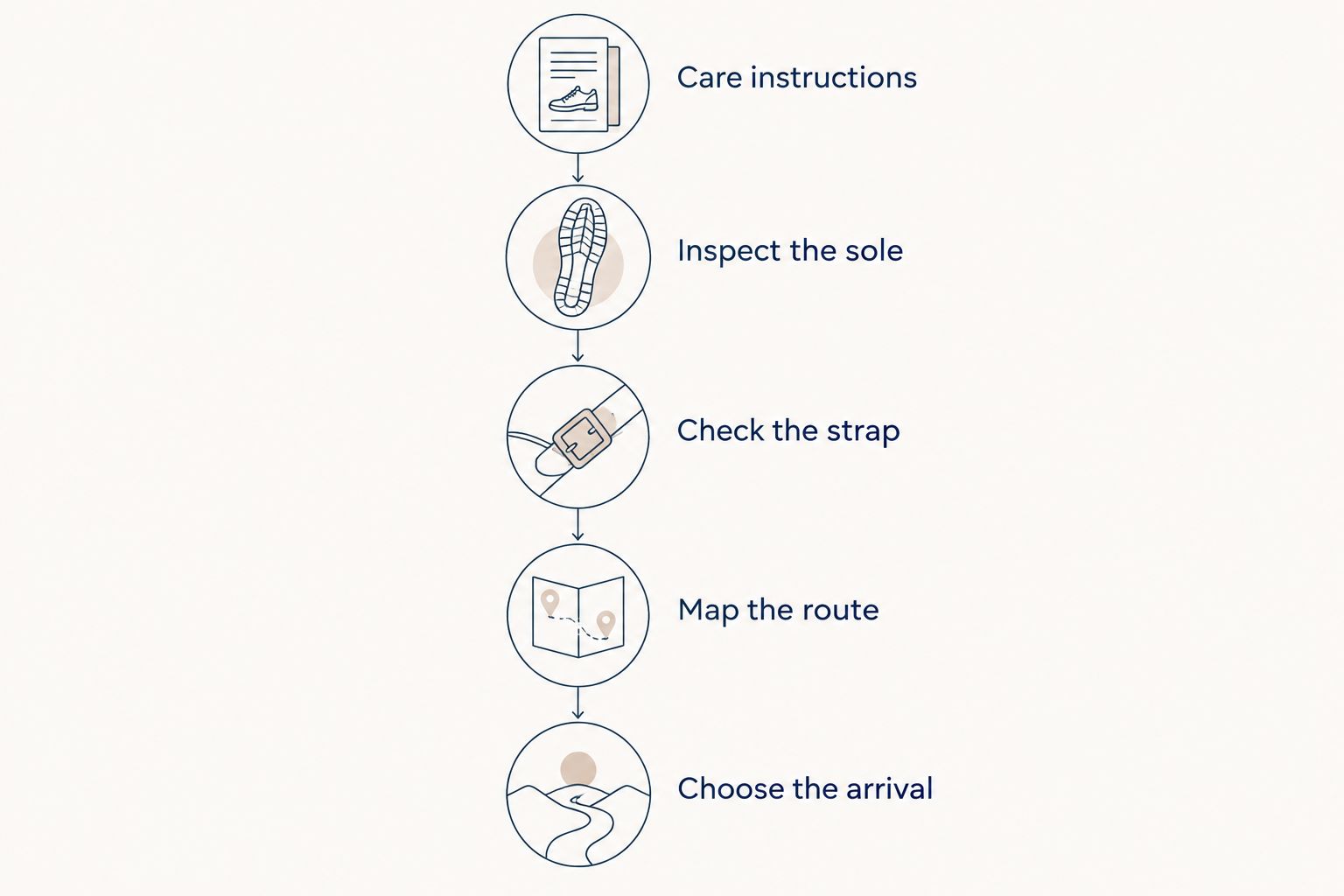
Do not deliberately wet a floor to conduct a home grip test. A cautious indoor fit check answers whether the shoe stays on your foot; it does not certify wet-surface traction.
No. A protective treatment is not evidence that the complete shoe is waterproof or suitable for wet walking. Follow the treatment manufacturer’s instructions and the shoe maker’s care guidance together.
Check compatibility with the exact material, finish and decorative components before applying anything. Follow any instructed patch test, application method and drying requirements rather than borrowing instructions from another product.
Keep the claims separate:
None of those establishes the others. Do not apply a treatment to the outsole or footbed unless the instructions explicitly permit that use.
For your 2026 care routine, buy a treatment because its documented use matches the material, not because its name sounds reassuring. There is no useful shortcut around compatibility.
HOPE ROZA defines Performance Luxury as the union of fashion design, sport-science principles, engineering, measurable wearability, material intelligence and luxury expression. The relevant principle here is precision: different performance claims answer different questions.
Air Vault™ is HOPE ROZA’s patent-pending triple-layer sole architecture for refined heels. It is engineered to manage impact, return energy, distribute pressure and reduce loading beneath the forefoot while preserving a slim luxury profile.
Those are underfoot design objectives. They are not claims of waterproofing or wet-floor traction, and they should not be extended to a particular slingback without product-level confirmation.
HOPE ROZA’s Performance Luxury approach is intended for women dressing for consequential work and meaningful occasions. Its useful contribution to this decision is asking what the shoe must do after the entrance, while keeping weather suitability a separate requirement.
Move to a dry place first. If your foot is sliding, the strap is no longer secure or footing feels uncertain, stop wearing the pair until the problem is resolved.
Then follow the shoe’s material-specific care instructions. Do not continue wearing a damp shoe simply to dry it through use.
Where the care guidance permits, blot with a clean, soft cloth rather than rubbing aggressively. Avoid improvising with cleaning products, oils or household remedies.
Pay attention to the interior as well as the visible upper. A shoe can look dry outside while the footbed remains damp.
Follow the maker’s drying guidance and keep the pair away from radiators, hairdryers and other direct heat sources. Do not return damp footwear to closed storage.
Avoid promising yourself a fixed drying deadline. Material, construction and the extent of wetting affect the process, so assess the pair rather than the clock.
Check for changes in shape, finish, strap attachment, sole edges and heel-tip security. Seek advice from the maker or a qualified shoe repairer if anything has loosened, distorted or separated.
For a 2026 occasion wardrobe built around repeat use, care is part of value. So is declining to turn a repairable problem into further damage by wearing the shoe again too soon.
Yes, if the remaining route and surfaces suit the shoe. Stopped rain does not mean dry paving, clear puddles or dry entrance floors.
Look at the route itself. If it still requires wet walking, keep the same arrival plan you would use while rain is falling.
A secure strap matters, but tighter is not automatically better. Adjust only as the shoe is designed to allow, and check that the strap stays in place without digging in or pushing your foot forward.
Do not use over-tightening to compensate for a poor fit. If you have to change your stride to keep the shoe on, choose another pair for the occasion.
Can I wear slingback heels to a wedding when rain is forecast?
Yes, if the arrival and guest areas suit the shoes, or you carry them and change inside. Ask about exposed paths and the wet-weather event plan before choosing your pair.
Does a rubber outsole mean my slingbacks will not slip?
No, outsole material alone does not guarantee wet-surface grip. Surface conditions, outsole design, wear and any documented testing remain relevant.
Are closed-back pumps automatically better for rain than slingbacks?
No, a closed back provides more coverage but does not establish waterproofing or wet traction. Compare the exact shoe’s care guidance, construction and suitability for the route.
Can I wear wet slingbacks for the rest of the evening?
Do not continue if your foot slides, the strap loses security or footing feels uncertain. Change into suitable dry footwear and follow the wet pair’s care instructions.
Should I spray new slingbacks before their first outing?
Apply a treatment only when both the shoe’s care guidance and the treatment instructions permit it. Check compatibility with the exact material and finish first.
What should I ask before buying slingbacks for rainy-season events?
Ask about the upper material, moisture-care instructions, outsole care and any documented wet-surface limitations. Comfort claims and indoor wear assessments do not answer those questions.
Before the next important invitation, identify where you would change shoes if the arrival became wet. Ask the venue when necessary, rather than discovering the answer beside the entrance.
Then finish the outfit. The most useful rainy-weather accessory is a workable arrival plan, because it lets the shoes remain part of the occasion instead of becoming its logistical subplot.
Dress Like It Matters.


