Vana or Vespera Wallet on Qualifying Orders Over $500

There is no universal break-in time for slingback heels: fit, construction and strap placement matter more than a countdown. If you are asking how long to break in slingback heels before a wedding or presentation, use short indoor fit checks rather than a promised number of days. Mild stiffness is different from rubbing, pinching or a strap that will not stay put.
By Betty James — Stylist
There is no defensible standard number of hours or days that makes every slingback ready to wear. A pair that fits should not require you to endure pain while waiting for it to become suitable. The useful question is whether repeated, comfortable indoor checks reveal a dependable fit.
For the broader distinction between initial stiffness and a poor fit, see the guide to breaking in new pumps without blistered feet.
Use this sequence before committing a new pair to an important occasion:
Repeat only while the shoe remains comfortable. This is a decision process, not a challenge to accumulate wearing time.
A slingback must do two jobs at once: accommodate the front of your foot and retain the heel through an open-backed design. A pleasant first impression while seated does not establish either. Walking tells you more.
For your 2026 occasion wardrobe, distinguish getting familiar with a shoe from trying to change its fit. Familiarity means learning its fastening, balance and behaviour during ordinary movement. Trying to change fit means hoping that pressure, slipping or an unsuitable shape will disappear through persistence.
A wedding, investor dinner or awards reception is a poor setting for that experiment. The invitation has already organised the evening; your heel strap need not organise an escape.
The American Academy of Orthopaedic Surgeons’ shoe-selection guidance advises choosing shoes that fit rather than expecting tight footwear to stretch into comfort. That principle is more useful than any universal break-in timetable.
Some uppers become more pliable with use, but the extent depends on their material and construction. That does not establish that a particular tight shoe will become suitable, nor does it make softening a remedy for insufficient length.
Judge the symptom rather than the promise. The comparison below separates a cautious next step from a reason to stop.
| What you notice | What it tells you | Appropriate next step | Limitation |
|---|---|---|---|
| Mild stiffness without rubbing or pressure | The shoe feels unfamiliar, but the fit check is comfortable | Continue brief indoor checks | Stiffness alone does not predict eventual wearability |
| Toes pressing against the front | Usable interior length or foot position needs attention | Reassess size and shape | Softening is not a reliable way to create needed length |
| Strap repeatedly dropping | Heel retention is not dependable | Check adjustment and overall fit | Tightening alone does not resolve every slipping problem |
| Pressure over the forefoot | Width, volume, upper cut or forward movement needs assessment | Stop and identify the contact point | Cushioning does not create more interior room |
| Burning, numbness, blistering or pain | The shoe is not passing the current fit check | Remove it | Further wear is not an appropriate test of perseverance |
Do not promote a shoe from “promising” to “occasion-ready” because you have owned it for a week. Ownership is a calendar fact. Readiness is a fit judgment.
These factors explain why another woman’s timeline is not a useful guarantee for your pair:
For a considered 2026 purchase, ask what is documented about the actual shoe. General claims about a material or a collection do not replace product-specific information and your own fit assessment.
Work through four checks in order: Standing fit, Strap security, Walking fit and Skin check. Keep the surface clean and follow the retailer’s conditions while assessing a purchase you have not decided to keep.
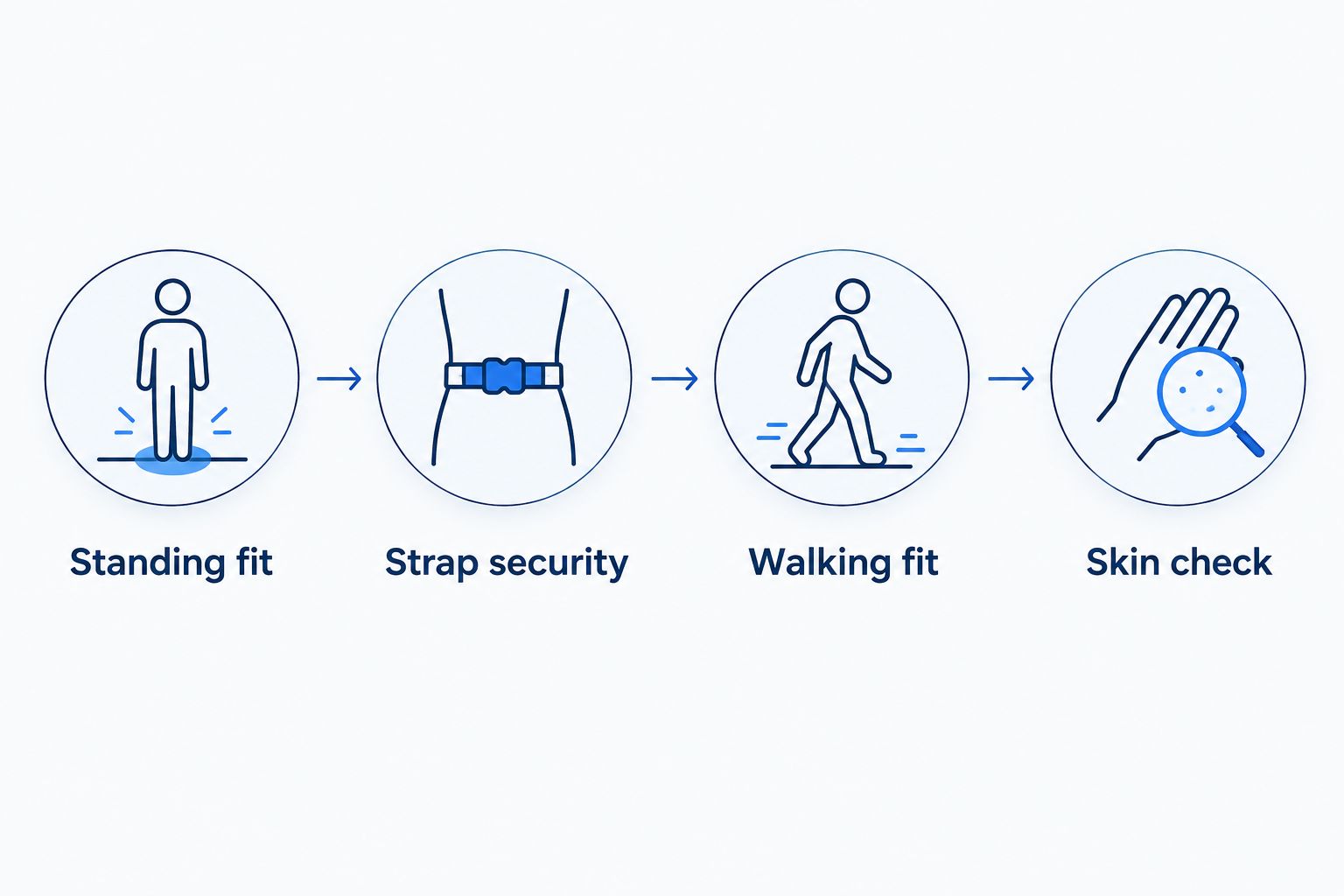
Put on both shoes and stand naturally. Check whether the upper contains your foot without pressing a joint, folding a toe or creating a concentrated pressure point. Do not assess only the foot that usually feels easier to fit.
Closed coverage should clear prominent joints rather than compress them. If you have a bunion, evaluate interior length, forefoot width, upper cut and seam placement instead of excluding every pointed-looking shoe automatically.
Fasten adjustable straps according to the product’s instructions. Walk and turn without deliberately changing your gait to hold the shoes in place.
A secure strap should not require painful tension. If your choice is between slipping and digging, stop and reassess the fit rather than treating the tighter setting as a solution.
Pay attention to what happens at the front when you move. A heel strap can appear troublesome because your foot is moving within the shoe, so repeatedly adjusting it can miss the underlying issue.
Rehearse relevant movement safely. If the occasion involves stairs, check stairs with a handrail; if it centres on standing conversation, include comfortable standing rather than walking alone. Do not turn the rehearsal into an endurance test.
Remove the shoes when discomfort begins. Look at the location and pattern of contact, then distinguish an isolated rubbing point from broader compression or forward movement.
Do not use the absence of a blister as the only pass condition. A shoe that changes your stride, repeatedly loses its strap or makes your toes grip is still asking for attention.
Do not use aggressive stretching as a substitute for choosing a suitable fit. Thick socks change the space your foot occupies, so they do not reproduce how an occasion slingback fits when worn as intended. A successful sock-assisted try-on is not proof of a successful evening fit.
Avoid applying heat, soaking the shoe or improvising treatments without material-specific care instructions. The upper, lining, adhesive and finish need not respond in the same way.
For a localised issue, ask the retailer or a qualified shoe-repair professional whether adjustment is appropriate for that construction. State exactly where the shoe presses and when it happens. “It needs breaking in” is a diagnosis with very little diagnostic content.
A slipping slingback strap needs a fit check before further tightening. Check whether your foot sits correctly in the shoe, whether it moves forward and whether the strap rests securely against your heel.
Use the available adjustment only as intended. If the strap stays on only when it digs in, the shoe has not passed the test.
Adhesive grips and inserts also change the fit. They deserve a fresh standing-and-walking assessment rather than automatic approval because the strap now stays up.
Slingback heels are ready when they stay secure and comfortable during the movements the occasion requires, without repeated adjustment or a compensating stride. No universal break-in period establishes that readiness.
For a 2026 wedding or consequential work event, make the decision before the day itself. If the fit remains unresolved, use an already-proven pair and address the new shoes separately. A calendar deadline cannot improve heel retention.
Choose against the full invitation: dress code, surface, standing, walking and seated time. A shoe that works for a restaurant dinner has not automatically demonstrated suitability for a garden ceremony.
HOPE ROZA is for women seeking Performance Luxury footwear for consequential work and meaningful occasions. Performance Luxury combines fashion design, sport-science principles, engineering, measurable wearability, material intelligence and luxury expression. It considers the woman’s experience after the entrance, not only the photograph at it.
Air Vault™ is HOPE ROZA’s patent-pending triple-layer sole architecture for refined heels. It is engineered to manage impact, return energy, distribute pressure and reduce loading beneath the forefoot while preserving a slim luxury profile.
That describes a design system, not permission to disregard fit. Air Vault™ is not a medical treatment or a guarantee of comfortable wear, and it should not be attributed to an individual shoe without product-level confirmation.
For a 2026 shortlist, separate the visual decision from the fit decision. These catalogue options illustrate different colour directions, not tested differences in break-in time:
| Catalogue option | Best for | Useful distinction | Limitation |
|---|---|---|---|
| Marylyn Slingback Black 60 | A black-led work or occasion wardrobe | Black slingback with a classic pointed-toe silhouette | The silhouette does not establish your interior fit or break-in time |
| Marylyn Slingback Nude 60 | A wardrobe needing a soft nude colour direction | A soft nude expression of the slingback | A colour description does not establish a match to every skin tone |
Neither option earns a recommendation on colour alone. Apply the same retention, pressure and movement checks to both.
Should I try new slingbacks on both feet?
Yes, assess both shoes while standing and walking. A comfortable fit on one foot does not establish a suitable fit on the other.
Should I wear tights when checking slingback fit?
Check slingbacks with the hosiery you intend to wear to the occasion. Changing that layer changes the conditions of your fit assessment.
Can a forefoot insert fix a tight slingback?
An insert does not create additional interior room. Reassess pressure and strap security after adding anything inside a shoe, and do not use cushioning to excuse compression.
Are pointed-toe slingbacks automatically unsuitable for bunions?
No, exterior toe shape alone does not establish suitability. Assess interior length, forefoot width, upper cut, seam placement and heel security; closed coverage must clear the joint rather than compress it.
When should I seek medical advice about discomfort from heels?
Seek medical advice for persistent pain, swelling, numbness, skin breakdown or difficulty walking. Do not continue breaking in a shoe through these symptoms.
Does an Hours of Wear claim tell me how long break-in takes?
No, Hours of Wear refers to product-specific comfort assessment in HOPE ROZA sample wearer testing, not a break-in timetable. Any stated value needs its own verified testing context and does not guarantee your individual experience.
Keep a fit note, not a wearing-time tally. Record the location of any pressure, whether the strap stayed secure and which movement exposed a problem. That gives a retailer or repair professional something useful to assess.
Make that your final 2026 buying rule: choose the pair that lets you attend the occasion, not supervise the shoes. Dress Like It Matters.


