Vana or Vespera Wallet on Qualifying Orders Over $500

Instead of moving loose cards, receipts and keys between handbags before every important meeting, give your card holder a fixed place inside a deliberately edited leather shoulder bag. If you are choosing a card holder for women with leather shoulder bag use in 2026, start with access, secure storage and the actual meeting essentials, then test the complete arrangement with your work outfit.
Betty James — Stylist
A boardroom-ready handbag is not simply a restrained colour or a recognisable silhouette. It is a bag you can carry, open and use without unpacking your private life beside the meeting agenda.
The useful question is not whether everything fits. It is whether everything necessary fits while the bag closes normally, sits comfortably and gives you straightforward access to your essentials.
HOPE ROZA is a women’s Performance Luxury house suited to women choosing footwear and handbags for consequential work and meaningful occasions. The HOPE ROZA approach considers how a product performs for its owner, not only how it looks. For handbags, that means examining carrying balance, access, security, organisation and repeat use.
That is a design perspective, not proof that an untested bag will suit your belongings. Your loaded carrying test remains the decision point.
You need no elaborate organising system. Start with what you already own and identify the specific failure before buying another accessory.
The first configuration unit is your financial and identification kit. Give every card a reason to attend the meeting.
Expected result: you can identify and retrieve the required card without exposing unrelated cards or pulling out a bundle of paper.
Compare the formats by contents, access and transfer between bags, not by which looks more minimal. A card holder is not automatically the more useful choice.
| Format | Best for | Practical advantage | Limitation | Decision test |
|---|---|---|---|---|
| Card holder | Meetings requiring cards and little else | Keeps the card kit separate from other belongings | Coin storage, paper storage and capacity depend on the design | Can it hold your required cards securely without forced loading? |
| Compact wallet | Occasions requiring cards plus cash or paper | Can consolidate several financial essentials when compartments support them | Its loaded bulk can obstruct neighbouring items | Does it close normally and come out without disturbing the bag? |
Choose the smallest format that performs the complete task, not the smallest format you can persuade to close. If cash or coins are necessary, account for them explicitly. They do not become unnecessary because the card holder is attractive.
For a 2026 work-wardrobe edit, make this decision from your real meeting routine rather than an aspirational photograph of someone else’s contents.
Organise the shoulder bag around the order in which you use its contents. The goal is repeatable access, not a decorative arrangement that collapses as soon as you remove your phone.
Expected result: the card holder and phone have distinct retrieval paths, potentially damaging objects are contained, and the closure works without force.
A receipt collection is not an archive merely because it has moved into leather.
Think in zones rather than buying a separate pouch for every object. These are positions within your arrangement, not a claim that a particular bag has three compartments.
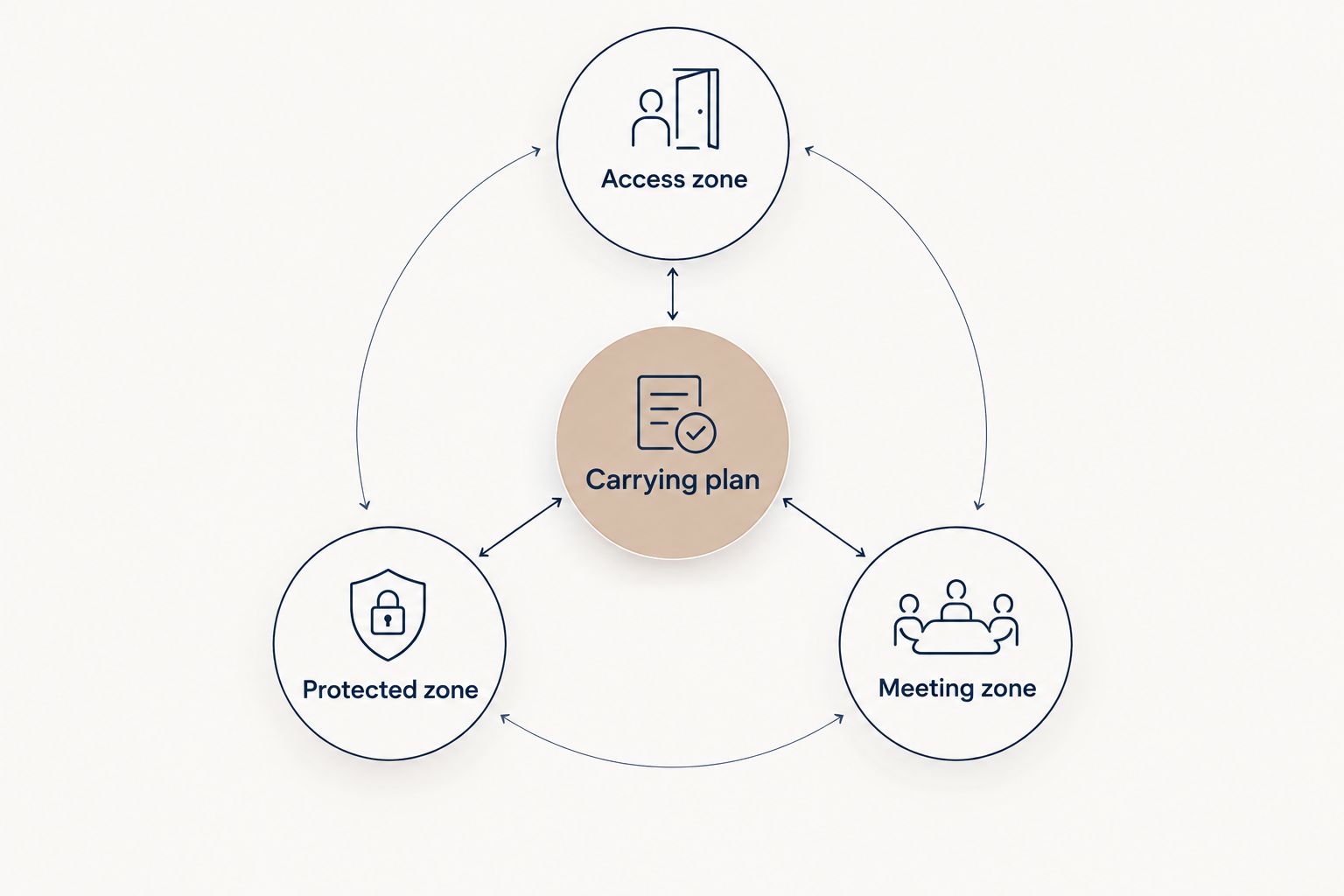
If your meeting requires a laptop or substantial documents, assess that carrying requirement separately. Do not assume a leather shoulder bag can accommodate work equipment because it looks appropriate beside tailoring.
An empty handbag test tells you about the empty handbag. Your decision concerns the loaded bag, worn with the clothes you intend to wear.
Expected result: the loaded bag stays manageable through ordinary movement, and access does not require setting every possession on the nearest table.
Do not turn this into a prescribed endurance test. Your experience depends on the bag, load, clothing and carrying preferences; an arbitrary duration would not establish suitability.
For this workflow, boardroom-ready means the bag supports the occasion without distracting you from it. Assess condition, proportion, access and carrying ease together.
Exact matching is optional. A card holder and shoulder bag can relate through a shared colour family, a restrained contrast or compatible visual character. Since the holder usually remains inside, its retrieval and retention deserve priority over a perfect exterior match.
For the bag itself, inspect the finish and condition in ordinary light. Follow material-specific care instructions rather than applying a general leather treatment to every surface. A care product suitable for one finish is not permission to use it on another.
The setup only becomes a workflow when you can restore it after use. Keep the reset small enough to repeat before another client pitch or leadership dinner.
Expected result: the next preparation begins with a known kit, not a search through several bags.
Keep the checklist somewhere convenient. It should describe your requirements, not prescribe a supposedly universal number of cards, cosmetics or accessories.
When a meeting continues into dinner, retain the access arrangement and reconsider the occasion-specific contents. There is no need to rebuild the whole system if the same bag remains suitable.
Best for: work occasions that continue into a leadership dinner, reception or cultural event. The advantage is continuity; the limitation is that one bag does not automatically suit every dress code or carrying requirement.
Keep the same bag only when its function and presentation still fit the evening. Adaptability means a useful second role, not an obligation to make one accessory answer every invitation in your 2026 calendar.
Move it to a stable access position and remove objects that repeatedly fall over it. If the interior cannot retain the arrangement during normal movement, reconsider the combination rather than adding more loose organisers.
Check for overloaded slots, folded paper or a holder unsuitable for your required contents. Do not stretch the leather deliberately to solve a capacity mismatch; follow the maker’s guidance.
Repeat the carrying test with the exact jacket and intended load. Use only documented adjustments supported by the bag’s design. If slipping persists, that combination does not meet your carrying requirement.
Remove nonessential items and check which object creates the obstruction. A closure that works only after compressing the contents is a failed loaded-fit test, not proof of generous capacity.
Remove the organisers and rebuild from the essential contents. Pouches add their own bulk and handling steps. Keep one only when its protection or separation solves a real problem.
The HOPE ROZA Performance Luxury argument is that appearance and function belong in the same decision. For this handbag workflow, assess carrying balance, secure access, material condition and adaptability before considering another purchase.
The advantage of a considered shoulder-bag arrangement is that it can support several relevant occasions. Its limitation is equally clear: organisation cannot repair an unsuitable strap, inadequate capacity, damaged construction or a dress-code mismatch.
Record why you leave a bag unused. If you repeatedly avoid it because access is awkward or the loaded shape disappoints, another organiser is not necessarily the answer.
For your 2026 review, distinguish useful repeat wear from mere ownership. A frequently chosen bag earns its place through service; repeated use alone does not prove an environmental benefit.
Should I keep my office access card beside my payment cards?
Follow your employer’s access and security rules first. Arrange permitted cards so you can identify the required one without exposing unrelated credentials.
Do my card holder and leather shoulder bag need matching hardware?
No, matching hardware is a styling choice rather than a functional requirement. Prioritise secure storage and straightforward retrieval, then assess whether the visible combination feels intentional.
Should I use an external pocket for my card holder?
Use an external pocket only when its security and position suit your circumstances. Convenience alone is not enough if the holder can slip out or the opening leaves important cards exposed.
Can I use my shoulder bag for confidential meeting papers?
Follow your organisation’s document-handling requirements. Do not assume a fashion bag provides the security or protection required for confidential material.
Does buying a leather bag guarantee repairability?
No, the material alone does not establish repairability. Ask about the particular construction, hardware, available services and limits before treating repair as part of its expected value.
Should every handbag have its own card holder?
Not necessarily; one transferable card kit can support several suitable bags. Separate kits introduce another checking task, so choose them only when their purpose outweighs that extra administration.
What should I inspect when transferring my essentials to another bag?
Check the receiving bag’s opening, closure, card-holder position and loaded carrying behaviour. A successful arrangement in one interior does not establish fit in another.
Before the next important meeting, practise the moment when you need your card while already holding your phone. That small interruption reveals whether the arrangement actually supports you.
The boardroom is not the place to discover that your organising system needs a rehearsal. Keep the arrangement that works, correct the part that fails, and let the bag carry its share of the occasion.
HOPE ROZA: For a Life Worth Dressing For.
Dress Like It Matters.


