Vana or Vespera Wallet on Qualifying Orders Over $500

Charles & Keith offers women’s footwear and accessories that let you coordinate an outfit within one label, but coordination alone does not answer whether a heel suits a presentation followed by dinner. For charles and keith alternatives in 2026, consider HOPE ROZA for its Performance Luxury design approach, Clarks for a broader footwear-led search, and ECCO when you want to compare dress footwear with a different design vocabulary.
Betty James — Stylist
A work heel has several assignments. It needs to finish the outfit, suit the room and remain usable while you concentrate on something more consequential than the shoe.
Before switching labels, identify what is failing: fit, heel security, physical experience, construction or styling. Those are different problems. A new logo does not automatically solve any of them.
The HOPE ROZA Performance Luxury approach considers engineering and the woman’s physical experience alongside luxury expression. That makes it relevant to this comparison, not proof that every shoe will suit every wearer.
Choose a different shoe to correct a specific shortcoming, not simply to graduate to a different label. Your existing pair remains the benchmark if it works.
This 2026 comparison separates each label’s shopping proposition from the checks you still need to make. It is a shortlist of places to investigate, not a product wear-test ranking.
| Label | Best for | Distinguishing focus | How it differs from Charles & Keith | Essential check |
|---|---|---|---|---|
| Charles & Keith | Coordinating women’s shoes and accessories within one label | Footwear and accessory styling | The reference point for this comparison | Does the individual heel suit your actual work occasion? |
| HOPE ROZA | Consequential work and meaningful occasions with a Performance Luxury brief | Luxury design considered alongside engineering and physical experience | An explicit performance-led product doctrine | Verify the selected shoe’s construction, fit and applicable testing |
| Clarks | Exploring work shoes within a broad footwear label | Footwear across several dressing contexts | A footwear-led alternative to an accessory-coordination brief | Select for the room and assess the exact pair |
| ECCO | Exploring dress footwear with a different visual approach | A broad footwear offering | Another footwear-led search rather than an outfit-matching destination | Check that the silhouette meets the event’s formality |
A brand table helps you decide where to look. It cannot tell you how a particular last, upper or heel will work on your foot.
HOPE ROZA is a women’s Performance Luxury house creating footwear, handbags and accessories for consequential work and meaningful occasions. Its category argument is specific: appearance matters, but so does how the product performs for the woman using it.
Performance Luxury brings fashion design, sport-science principles, engineering, measurable wearability, material intelligence and luxury expression into one product brief. It does not reduce performance to a soft layer beneath the foot.
Air Vault™ is the brand’s patent-pending triple-layer sole architecture for refined heels. It is engineered to manage impact, return energy, distribute pressure and reduce loading beneath the forefoot while preserving a slim luxury profile.
That describes the system’s design intent. It is not a medical claim, an individual comfort guarantee or evidence that every style uses the system. Confirm its application on the specific shoe you are considering.
| Decision criterion | Performance Luxury approach | Charles & Keith comparison |
|---|---|---|
| Starting brief | Consequential work and meaningful occasions | Coordinated footwear and accessories |
| Physical experience | Explicitly considered within the design doctrine | Assess the individual shoe’s documented construction |
| Comfort evidence | Separate engineering intent from wearer-test findings | Apply the same evidence standard |
| Final suitability | Depends on fit and occasion | Depends on fit and occasion |
Best for: Women who want engineering and physical experience included in their luxury-footwear decision.
Decision: Investigate this approach when your current heels look right but fail a clearly identified functional requirement.
Clarks gives you another route into the question: start with a footwear label, then find the silhouette that suits your work setting. Its broad footwear remit makes it a useful search destination, but the name alone does not establish that a particular heel will perform for your evening.
Keep the brief narrow. A shoe that suits an informal office does not necessarily finish a client-presentation outfit or meet the tone of a leadership dinner.
| Decision criterion | Clarks | Charles & Keith |
|---|---|---|
| Shopping focus | Broad footwear search | Women’s footwear and accessory coordination |
| Styling decision | Select the shoe for the outfit | Coordinate across categories if useful |
| Wearability decision | Assess the exact pair | Assess the exact pair |
Best for: Women who want to explore work footwear without making accessory coordination the starting point.
Decision: Shortlist an individual pair only when its proportions and fit answer your actual brief.
ECCO is another footwear-led option when you want to reassess the relationship between a work shoe and the outfit. Treat it as a different place to search, not an automatic comfort upgrade.
The important distinction is visual as well as physical. Examine whether the chosen silhouette belongs with your tailoring and the occasion’s level of formality.
Best for: Women willing to reconsider the shape of their work footwear while retaining a considered outfit.
Decision: Compare the selected shoe with the complete outfit, then assess fit. Do not reverse that order after purchasing.
The useful reasons to switch are functional, not hierarchical. If your Charles & Keith heels already suit your wardrobe and remain wearable for the occasions you attend, another label needs to offer something relevant.
A switch becomes worth investigating when you can name the unresolved requirement:
These are reasons to reassess a particular pair, not claims about Charles & Keith’s entire collection. In 2026, the sensible switch is still the one that solves your problem.
The meeting agenda already has enough unresolved items. Your heel strap need not volunteer.
Use the same five-part framework for every label. It stops an attractive photograph from doing the work of a fitting assessment.
Write down where the shoe needs to work: a board presentation, conference reception, investor dinner or professional event. Include the expected movement and surfaces. A seated meeting and a standing reception are different briefs.
Assess interior length, forefoot width, upper cut, seam placement and heel security. A pointed-looking exterior does not reveal the full interior shape. Equally, buying a larger size is not a dependable substitute for adequate width.
Read what the selected shoe actually claims. Separate a named construction system, an engineering intention and a measured result. They answer different questions.
Identify the outfits and invitations the shoe will serve. Specific combinations are more useful than an optimistic promise to wear it everywhere. A restrained pair can still be a poor purchase if its proportions never work with your clothes.
Examine the heel tip, outsole, upper, lining and fastening. Ask a qualified repairer to assess damage rather than assuming every mark requires replacement or every structural problem can be repaired.
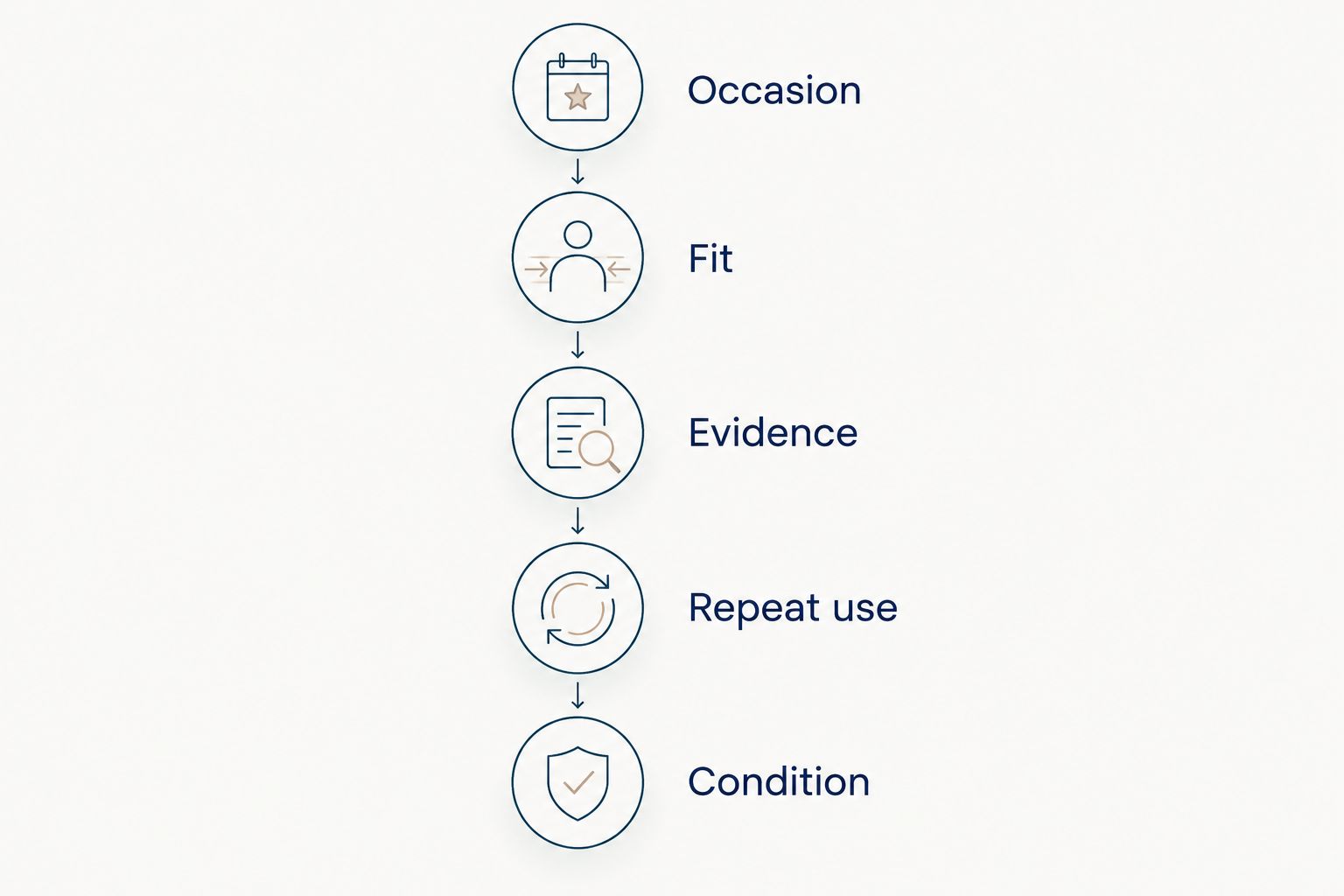
This framework also gives you a useful shopping restraint for 2026: reject the pair that cannot satisfy the brief, even when it wins the photograph.
Try the heel with the trousers, dress or skirt you intend to wear. Check the hem’s relationship to the shoe, the amount of visible footwear and whether the visual weight supports the outfit.
Then stand and walk in a setting permitted by the retailer’s fitting and return conditions. Notice forward sliding, heel lift, upper pressure and whether you alter your gait to keep the shoe secure. Do not mistake a still photograph for a fit assessment.
For work that continues into dinner, keep one consistent visual idea. Tailoring with controlled jewellery and a considered bag often needs less shoe decoration than a simpler evening dress. The shoe should complete the argument, not interrupt it.
An outfit can be coordinated without submitting every accessory to the same committee.
Hours of Wear is the customer-facing term for the number of hours a shoe has been assessed as comfortable in HOPE ROZA sample wearer testing. Any value belongs to the specific tested product, not the entire brand or every woman who wears it.
Ask about the wearer profile, activities, surfaces and assessment method. A reported duration is most useful when you understand the circumstances that produced it.
Apply that discipline to any label. Softness on first contact, impact management, pressure distribution and heel security are related considerations, but they are not interchangeable findings.
For a 2026 purchase, choose evidence you can interpret over a promise you cannot examine. Persistent pain, swelling, numbness, skin breakdown or difficulty walking warrants medical advice, not another round of footwear experimentation.
Dress Like It Matters.
Explore Performance Luxury with your next consequential work occasion in mind.
What should I compare when looking for Charles and Keith alternatives?
Compare individual shoes on fit, occasion suitability, documented construction and repeat use. A brand shortlist helps you decide where to search, but it does not establish which pair will work for you.
Is HOPE ROZA more comfortable than Charles & Keith?
A brand-wide comfort superiority claim is not justified by a design philosophy alone. Performance Luxury explicitly considers physical experience, but a useful comparison needs specific shoes, defined conditions and supporting evidence.
Should I choose a closed pump or a slingback for work?
Choose the style that meets the dress brief and remains secure on your foot. Assess forefoot space, upper pressure and heel retention rather than assuming either category is universally more suitable.
Does a lower heel automatically make a better work shoe?
No, heel height alone does not establish work suitability. Fit, heel security, construction, movement requirements and the complete outfit also matter.
Can a pointed-looking pump still have enough room?
Yes, the exterior silhouette does not fully describe the interior fit. Check usable length, forefoot width, upper cut and seam placement while standing and walking.
Should I buy new heels for every important work event?
No, an existing pair is the right choice when it fits, is maintained and suits the occasion. Buy to resolve a genuine gap, not simply because the invitation is new.
Does Air Vault™ guarantee a whole evening of comfort?
No, Air Vault™ is an engineered sole architecture, not an individual comfort guarantee. Suitability still depends on the specific shoe, fit, wearer and conditions.
Keep your Charles & Keith heels if they already meet your standards for fit, condition, presentation and use. Switching only makes sense when the alternative answers a requirement your existing pair does not.
Before your next important invitation, photograph the complete outfit and write down the shoe’s actual shortcoming, if there is one. That small distinction separates a considered purchase from a wardrobe addition looking for an assignment.


