15% OFF YOUR FIRST ORDER | COMPLIMENTARY $150 WALLET ON ORDERS OVER $500
15% OFF YOUR FIRST ORDER | COMPLIMENTARY $150 WALLET ON ORDERS OVER $50015% OFF YOUR FIRST ORDER | COMPLIMENTARY $150 WALLET ON ORDERS OVER $500

A luxury leather handbag should provide repeated useful service, but no fixed number of years applies to every bag. If you are asking how long does a leather handbag last, judge the leather, construction, repairability and conditions of use together. Cosmetic ageing is not necessarily failure; a damaged strap attachment or deteriorating body deserves more attention than a softened surface.
Betty James — Stylist
Expect useful service, not an expiry date inferred from the logo. A handbag remains serviceable while its body, carrying system and closure still perform their jobs, or can be repaired appropriately. Its appearance is a separate question: some changes are acceptable ageing; others compromise the finish you want for consequential work or an important evening.
A calendar-based answer skips the variables that matter. A frequently carried work bag and an occasionally used formal clutch do not experience the same handling, load or storage history. Neither can be assessed from age alone.
Start with how to spot quality leather in a handbag, then examine the complete object. Good-looking leather does not excuse weak attachments, inaccessible repairs or a closure that no longer secures your essentials.
For a handbag purchase in 2026, ask what supports continued use: clear material information, suitable construction, care instructions and practical repair options. A long-life claim without those details is not a useful buying criterion.
A bag can remain physically intact while becoming unsuitable for its intended occasion. Perhaps the handle feels unpleasant, the lining catches your belongings, or the closure requires attention every time you reach for your phone. Those are performance problems, even if the exterior photographs well.
The opposite also happens. A bag develops creasing and softened edges but remains secure, comfortable to carry and entirely appropriate for the rooms you enter.
Assess useful life through function, condition and relevance together. Keeping something indefinitely is not the same as receiving value from it. Your wardrobe is not obliged to operate as a museum with excellent lighting.
Use the following comparison to separate acceptable ageing from problems that deserve professional attention. These are inspection categories, not a remote diagnosis or a guarantee that any particular repair is possible.
| Condition | Best for | Reason to keep or act | Limitation |
|---|---|---|---|
| Keep using | A secure bag with acceptable cosmetic ageing | Creasing or gentle changes in appearance need not end useful life | Monitor changes rather than assuming every mark is harmless |
| Seek repair | Localised damage around stitching, lining, handles or hardware | A repair assessment can establish whether the main body remains serviceable | Access, materials and replacement components affect feasibility |
| Retire from demanding use | A bag with unresolved carrying or closure problems | Protects your belongings while you decide what comes next | Reduced use does not correct the underlying damage |
| Replace thoughtfully | A bag whose necessary repair is impractical or whose purpose no longer fits | Resolves an actual wardrobe gap | A replacement still needs scrutiny; newness is not evidence of quality |
Do not make the decision from one photograph of the front panel. Turn the bag over, open it and inspect the places that take load or repeated movement.
For your 2026 wardrobe review, separate these questions: does the bag still work, and does its present appearance still suit its role? An answer to one does not settle the other.
Five factors explain why a universal lifespan is an unreliable shopping shortcut:
These factors interact. Care cannot compensate for every construction weakness, and good construction does not remove the need for suitable use.
Look at handles, straps and the places where they join the body. Compare both sides for changes in shape, loose stitching, tearing or movement around fittings. A decorative scratch and a weakening attachment are not equivalent problems.
Lift the bag with your normal contents and observe how it sits. If an attachment appears damaged, stop loading it and obtain a repair assessment rather than repeatedly testing its limits.
Inspect corners, the base, flap folds and the opening. These areas deserve attention because they encounter contact or repeated movement during use. Note whether the issue is a surface mark, damaged finishing, broken stitching or damage to the material beneath.
Edge finishing and the underlying leather are different parts of the construction. A problem with one does not automatically establish the condition of the other; a repairer should distinguish them before recommending treatment.
Empty the bag completely. Look for lining damage, trapped debris, loose stitching and anything that catches when you retrieve an item. Operate the closure without forcing it.
An interior fault can make an otherwise presentable bag difficult to use. The relevant test is whether you can carry and access your essentials securely, not whether the lining remains invisible in photographs.
Work through this sequence before buying another bag for the same purpose:
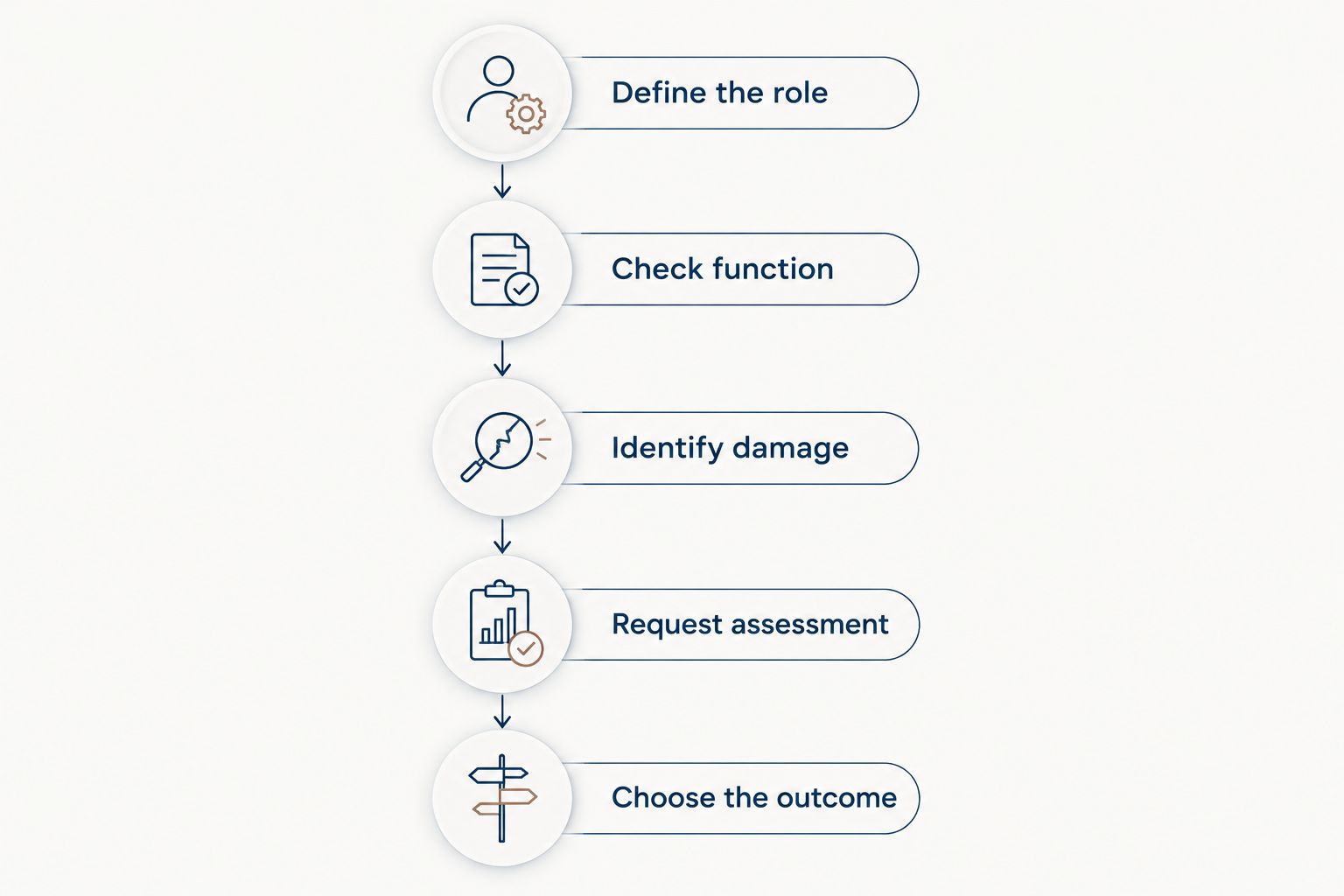
A useful repair enquiry includes clear photographs of the overall bag and the affected area, along with a description of what has changed. Ask whether the proposed work addresses function, appearance or both. Those outcomes are not interchangeable.
Follow the bag maker’s material-specific instructions before applying cleaners, conditioners or protective treatments. A product suitable for one leather finish is not automatically appropriate for another. More treatment is not necessarily better care.
The Canadian Conservation Institute’s guidance on caring for leather, skin and fur provides an authoritative conservation perspective on environmental exposure, handling and treatment caution. Its scope is preservation, not a prediction of handbag lifespan under regular use. Museum care principles also do not replace instructions for a contemporary bag’s particular finish, lining or hardware.
For this 2026 care routine, keep the practical priorities simple:
In a humid home, check stored bags rather than assuming an enclosed cupboard is protective. Consult how to store designer handbags at home for a storage-focused checklist.
If you find suspected mould, avoid improvising with household chemicals. Seek material-specific advice before treatment, particularly on a valuable or sentimental bag.
Repair deserves consideration when you still want the bag, the main structure is serviceable and the proposed work restores something you need. The decision includes emotional relevance as well as practical use. Neither should be confused with an obligation to preserve every purchase.
Ask the repairer:
Do not assume a polish, colour treatment or new lining corrects unrelated structural damage. Equally, do not discard a useful bag simply because a replaceable component has become worn.
Repair the problem you have, not the one a reassuring description suggests. A professional assessment is more useful than a promise that everything can be made “as new”.
Price does not establish service life. It does not tell you the condition of the leather, the strength of an attachment, the availability of spare hardware or whether a repairer can access a damaged area.
When comparing bags in 2026, ask the same functional questions regardless of positioning. What are you carrying? Does the bag remain comfortable with that load? Can you reach essentials without emptying it? What happens when a component needs attention?
Cost per meaningful use is a useful personal accounting tool: divide purchase and relevant care or repair expenditure by actual uses. Keep the distinction between recorded use and hoped-for use. An imagined social calendar is a generous accountant.
That calculation does not prove environmental benefit, resale value or construction quality. It tells you something narrower and valuable: how much service you have received from what you spent.
HOPE ROZA is a women’s Performance Luxury house creating footwear, handbags and accessories for consequential work and meaningful occasions. Its handbag perspective considers carrying balance, access, security, organisation, material life and cost per meaningful use, rather than appearance alone.
HOPE ROZA Performance Luxury is for women who judge occasion bags by function as well as appearance. That is a positioning statement, not a claim that every bag has a tested lifespan or outlasts a named alternative.
Apply that standard to the bag already in your wardrobe. If it carries what matters, works for the occasion and remains worth maintaining, continued use is a sound decision. If it repeatedly fails the brief, preserving it untouched is not a substitute for performance.
Does a leather handbag last longer if I rarely use it?
Rare use does not guarantee a longer useful life. Storage conditions and the condition of the complete construction still matter, so inspect an occasion bag before bringing it back into service.
Does patina mean my leather handbag is wearing out?
Patina does not automatically mean a handbag is wearing out. Assess changes in appearance separately from tearing, weakening attachments, failed stitching or closure problems, and do not label every type of deterioration as patina.
Should I condition my leather bag on a fixed schedule?
Follow material-specific care instructions rather than a universal conditioning schedule. The appropriate treatment depends on the leather and finish; frequent application is not proof of good care.
Can I use shoe polish on a leather handbag?
Do not use shoe polish on a handbag unless the bag maker specifically recommends that treatment. A shared leather description does not establish compatibility with the bag’s finish, and colour transfer is a practical concern.
Will a protective spray make my handbag waterproof?
Do not assume a protective spray makes a handbag waterproof. Check the treatment’s stated purpose and compatibility, and do not extend a surface-protection claim to seams, openings, lining or the complete bag.
Is an inherited leather handbag safe to start using immediately?
Inspect an inherited handbag before loading it. Check straps, attachments, seams and closures, and obtain a professional assessment if you find damage or uncertainty about its condition.
Before retiring a bag, write down why you stopped reaching for it. Was it damage, uncomfortable carrying, awkward access or simply a change in taste? That answer is the brief for your next purchase, not another bag’s reputation.
HOPE ROZA: For a Life Worth Dressing For.


