15% OFF YOUR FIRST ORDER | COMPLIMENTARY $150 WALLET ON ORDERS OVER $500
15% OFF YOUR FIRST ORDER | COMPLIMENTARY $150 WALLET ON ORDERS OVER $50015% OFF YOUR FIRST ORDER | COMPLIMENTARY $150 WALLET ON ORDERS OVER $500

Instead of choosing a different pair for every wedding invitation, plan AVERYN™ Lock wedding weekend shoes around one confirmed compatible base and occasion-specific ornaments, then check that the shoe suits each venue and outfit. The system changes the shoe’s expression, not its fit or suitability for every surface: approve the base first, then plan the changes.
Betty James — Stylist
A wedding weekend is not one footwear assignment. A welcome dinner, ceremony and reception can ask different things of the same outfit, even before the venue changes.
HOPE ROZA’s AVERYN™ Lock is for women who want several occasion expressions from one confirmed compatible heel. Its value lies in adaptation, not in pretending that ornament changes solve every footwear problem. The HOPE ROZA Performance Luxury approach considers the woman’s experience alongside the appearance of the product.
AVERYN™ Lock is the brand’s patent-pending interchangeable ornament system. Its precision spring-lock mechanism allows compatible ornaments to be changed in under 60 seconds while remaining secure during wear. That describes the system, not a promise that every shoe or ornament belongs to it.
For your 2026 wedding calendar, begin with the hardest part of the weekend: the venue, movement or dress code that places the greatest demand on the shoe. An ornament cannot negotiate with gravel. It has excellent presentation skills and no authority over the ground.
If the product information does not settle compatibility, ask HOPE ROZA about your exact shoe and ornament pairing before building the weekend around it. Ask for the attachment, removal and secure-fitting checks as well. Do not substitute a generic shoe-clip tutorial for instructions for a precision spring-lock mechanism.
Expected result: every event has a clear brief, and you can distinguish a styling change from a genuine need for different footwear.
For a 2026 wedding weekend, the useful question is not “Can this shoe look different?” It is “Can this shoe do the required job before I change its appearance?” That distinction prevents a considered packing plan from becoming an exercise in optimism.
Judge the options by fit, venue suitability, outfit variation and preparation. Neither strategy wins without knowing the weekend.
| Strategy | Best for | Advantage | Limitation |
|---|---|---|---|
| Confirmed compatible base with interchangeable ornaments | Events where the same base suits the surfaces, movement and dress codes | Changes the visual expression without changing the whole shoe | Cannot change the base shoe’s fit, heel geometry or surface suitability |
| Different shoes for different events | A weekend with materially different footwear demands | Lets each event have footwear selected for its own conditions | Requires separate fitting, outfit checks and packing |
The adaptable strategy earns its place when the base genuinely works across the brief. Separate shoes earn theirs when conditions differ. Fewer products is a useful objective only when fewer products still meet the need.
Expected result: you have an approved base for specific occasions, not a blanket assumption that one heel covers the weekend.
Do not treat a short fitting as proof of comfortable wear throughout an event. Equally, do not invent an assessment duration or borrow another style’s result. Where a product has a verified Hours of Wear figure, read the product-specific testing context and limitations rather than interpreting the figure as a personal guarantee.
Performance Luxury combines fashion design, sport-science principles, engineering, measurable wearability, material intelligence and luxury expression. It asks how a product performs for the woman using it, not only how it appears.
Where confirmed for the chosen heel, Air Vault™ is HOPE ROZA’s patent-pending triple-layer sole architecture. It is engineered to manage impact, return energy, distribute pressure and reduce loading beneath the forefoot while preserving a slim luxury profile. Those are design purposes, not a medical claim or a guarantee of comfortable hours.
AVERYN™ Lock addresses a different requirement: adaptability. Do not infer that a shoe contains Air Vault™ because it has an interchangeable ornament, or infer interchangeable capability from cushioning claims. Confirm each system separately for the exact product.
Expected result: each approved event has a known shoe-and-ornament combination, and you understand how to change and check it.
The under-60-second system description concerns changing compatible ornaments. It is not a complete getting-ready allowance. Your dress, jewellery, bag, attachment check and missing earring are separate departments.
For the 2026 plan, keep a photograph of each approved outfit combination in your notes. Use it as a dressing reference, not proof that the shoe has passed a wear test. A photograph records proportion; your fitting records experience.
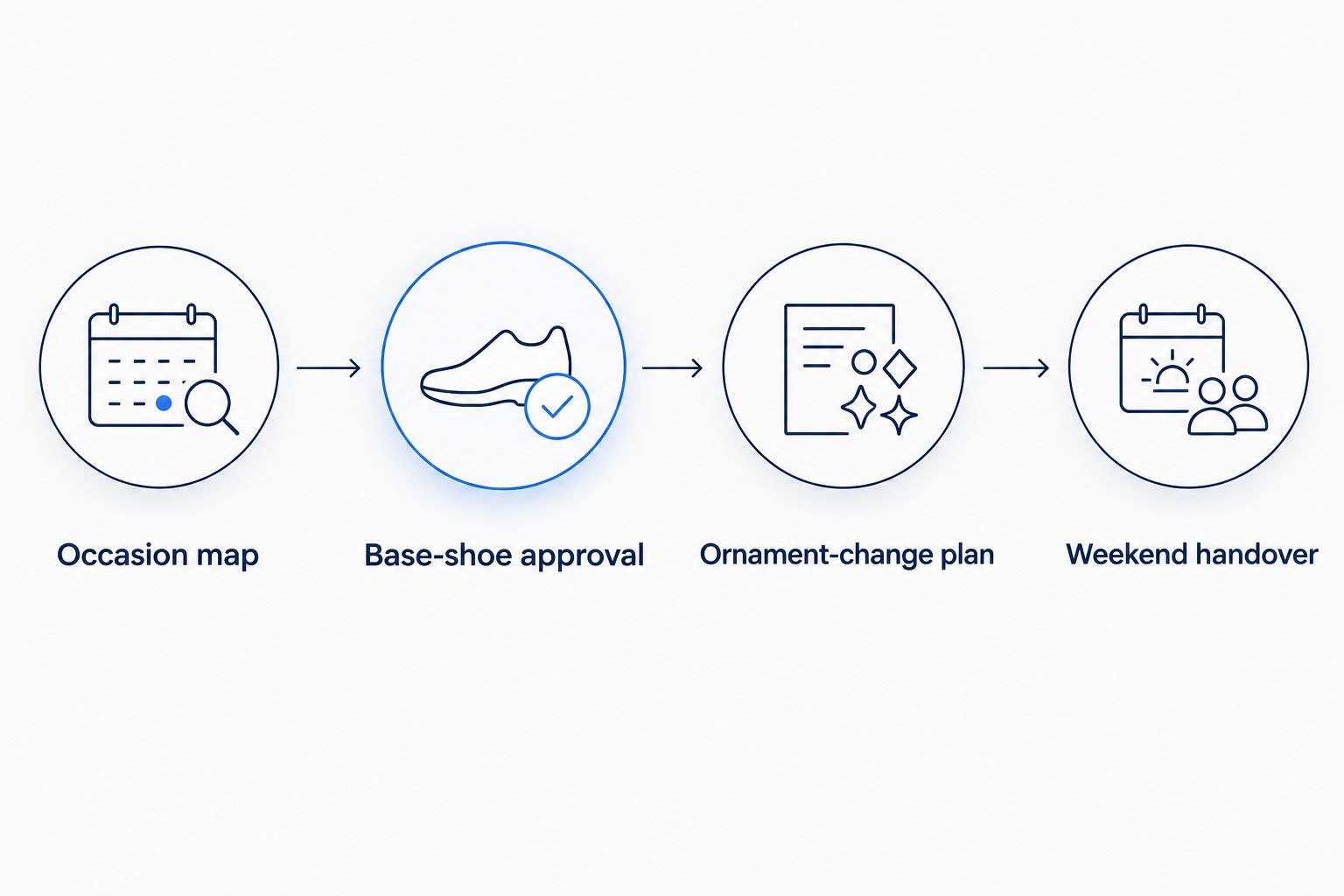
Expected result: the pieces arrive protected, the instructions remain accessible, and you know when the adaptable plan stops being appropriate.
A same-day transition works when the base shoe already suits both parts of the event. This is a styling workflow, not a substitute for reassessing comfort or venue conditions.
Expected result: the shoe gains another expression without an unnecessary full wardrobe change, provided the base still meets your needs.
For a 2026 ceremony-to-dinner schedule, allow yourself the option not to change anything. Adaptability means having a choice, not receiving another assignment from your accessories.
Stop and confirm the exact compatibility pairing and operating instructions. Do not force the mechanism, bend components or substitute adhesive. An unresolved attachment is a reason to pause, not an invitation to improvise.
Remove the shoe from the wearing plan until you have completed the specified secure-fitting check or obtained guidance. The system’s secure-wear design does not replace correct assembly or a check of your particular pieces.
Separate the events in your plan. Choose footwear appropriate to the ceremony route rather than assuming a different ornament changes ground contact or walking suitability.
Repeat the fit assessment with the intended hosiery and full outfit. If the problem persists, reconsider the shoe; do not automatically add an insert or size up without reassessing interior room and heel security.
Reject that plan. Stop wearing footwear that causes pain, and seek medical care for persistent pain, swelling, numbness, skin breakdown or difficulty walking. Neither modular styling nor sole engineering is a treatment.
After the wedding, record which combinations you actually wore and which remained theoretical. Note the occasion, fit observations, surface and reason for choosing each expression. This creates a useful wardrobe reference without turning personal impressions into product testing claims.
Apply that record to your next 2026 invitation before adding anything. The valuable addition is the one that serves a real occasion or extends a useful combination, not merely the one that looks different in its box.
For HOPE ROZA, the relevant value argument is adaptability and use frequency. One confirmed compatible base can offer several expressions, but modularity alone does not prove environmental benefit, repairability or a particular product lifespan.
Can I use AVERYN™ Lock ornaments on any wedding shoe?
No. Use AVERYN™ Lock ornaments only with a base shoe explicitly confirmed as compatible. A similar-looking bow, buckle or attachment does not establish compatibility.
Does an interchangeable ornament change how a heel feels?
An ornament change does not establish a change in fit, pressure management or walking suitability. Assess the base shoe separately and verify any performance construction for that exact product.
How quickly can I change compatible AVERYN™ Lock ornaments?
The precision spring-lock mechanism allows compatible ornaments to be changed in under 60 seconds. Follow the product-specific instructions and complete the specified secure-fitting check before wear.
Should I leave ornaments attached when packing wedding shoes?
Follow the storage and transport instructions for your exact shoe and ornament. Do not assume attached travel is appropriate, and protect separate hard pieces from rubbing against vulnerable finishes.
Can one base shoe cover an entire wedding weekend?
Only when the same base suits every relevant dress code, surface and movement requirement. Use separate footwear where conditions differ rather than asking an ornament change to solve a functional mismatch.
Does interchangeable footwear automatically count as sustainable?
No. Adaptability can support repeat use, but modularity alone does not prove an environmental benefit. Product life, repairability, materials, production and actual use need separate consideration.
Before buying another ornament, name the next occasion where you will wear it with the base you already have. If you cannot name one, keep the idea rather than adding the object.
The useful luxury is not an unlimited number of entrances. It is arriving with fewer unresolved decisions.
Dress Like It Matters.


