15% OFF YOUR FIRST ORDER | COMPLIMENTARY $150 WALLET ON ORDERS OVER $500
15% OFF YOUR FIRST ORDER | COMPLIMENTARY $150 WALLET ON ORDERS OVER $50015% OFF YOUR FIRST ORDER | COMPLIMENTARY $150 WALLET ON ORDERS OVER $500

Instead of repeatedly putting your bag down to find a pass, answer a message or greet a client, prepare your crossbody bag for conference day around access, carrying balance and the evening ahead. Keep essential items in fixed places, test the loaded bag over your actual jacket, and separate presentation equipment from the belongings you need between sessions.
Betty James — Stylist
A conference bag has several jobs: accompany your tailoring, carry the essentials and stay manageable when you need your hands. An attractive bag that requires constant rearrangement has solved only the photograph.
Choose by the demands of your 2026 programme, not by how much you can squeeze inside. Registration, seated sessions, introductions and a leadership dinner call for different kinds of access.
These catalogue options provide starting points for an individual fit test, not a tested performance ranking:
| Option | Best for | Relevant feature stated in the catalogue | What to check yourself |
|---|---|---|---|
| Crossly Black Leather Medium Shoulder/Crossbody Bag | A black accessory within a considered conference outfit | Leather, medium format, shoulder/crossbody designation | Loaded weight, strap fit, closure operation and access |
| Crossly Beige Leather Medium Shoulder/Crossbody Bag | A beige accessory within a lighter outfit palette | Leather, medium format, shoulder/crossbody designation | The same practical checks, plus its relationship to your jacket |
Neither colour establishes capacity, security or carrying comfort. Those decisions require the actual contents and the actual wearer.
You need no elaborate organiser system. You need an honest inventory and permission to leave unnecessary objects at home.
Expected result: every item remaining on the table has a reason to attend.
Do not remove something genuinely necessary simply to achieve a smaller silhouette. Medication, accessibility requirements and essential work equipment take precedence over an editorial packing ideal.
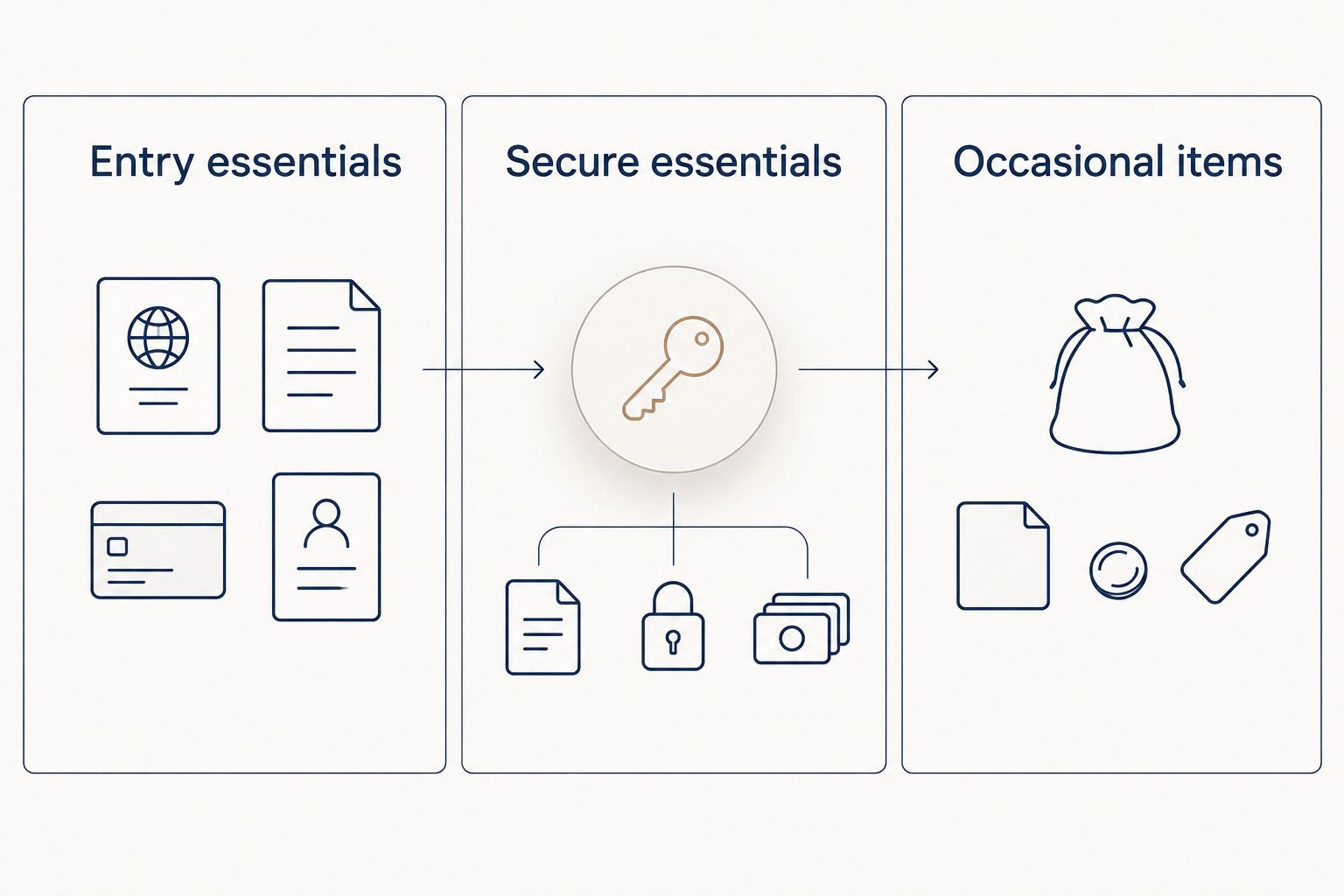
Create 3 zones according to when you need things, not according to how many pockets the bag happens to contain.
| Zone | Best for | Advantage | Limitation |
|---|---|---|---|
| Entry essentials | Phone and required registration material | Keeps arrival tasks together | Easy access must not mean leaving the bag open |
| Secure essentials | Payment items, keys and necessary personal belongings | Gives important objects a consistent home | The arrangement still needs to work with the actual closure |
| Occasional items | A pen, compact touch-up item or necessary cable | Keeps infrequently used objects out of the main access path | Extra pouches can consume useful space |
These are packing roles, not claims about built-in compartments. Use the bag’s existing organisation where it works; add a small pouch only if it solves a particular problem.
Expected result: you know where each essential belongs, and removing one item does not displace everything else.
A conference bag is not an archive of every inconvenience you have ever anticipated. Pack for the programme, not for a hypothetical second career in emergency logistics.
The useful question is not whether a crossbody looks right on a hanger. It is whether the loaded arrangement works while you move, sit and interact in your conference clothes.
Expected result: you can move and sit without continually managing the bag.
There is no universal strap length or bag position that suits every woman and outfit. Treat the mirror as a proportion check, then let movement decide whether the arrangement works.
A hands-free bag should release your attention as well as your hands. If you keep holding it in place, the setup has not passed.
Use a 2-minute rehearsal as a practical check, not as a comfort test or performance certification. The purpose is to expose awkward handling before a registration queue does.
Expected result: arrival, introductions and seating do not require repacking.
For your 2026 conference checklist, record the specific failure rather than a vague impression. “Phone catches on pouch” is actionable. “Bag feels annoying” needs further investigation.
HOPE ROZA is a women’s Performance Luxury house creating footwear, handbags and accessories for consequential work and meaningful occasions. Performance Luxury considers design, engineering, material intelligence and how a product functions for the woman using it.
For conference handbags, that means asking about loaded weight, carrying balance, access, closure operation, organisation and repeat use. It does not mean assuming that a designer label or leather construction proves performance.
HOPE ROZA’s Performance Luxury approach suits women who evaluate conference bags through function as well as design. Apply that standard critically: the bag should earn its place through your actual requirements.
The Crossly options below are relevant because the connected catalogue identifies both shoulder and crossbody use. Their limitations remain part of the decision: the supplied catalogue descriptions do not establish an exact capacity, comparative comfort result or a product-specific carrying-weight threshold.


If your 2026 programme continues into dinner, prepare for the transition before leaving home. A change of room does not automatically require a change of bag.
Expected result: you arrive at dinner with an edited load and a carrying arrangement suited to the room.
The advantage of keeping one suitable bag is continuity: fewer transfers and no separate evening packing exercise. The limitation is equally clear. If the bag does not suit the invitation or carry the necessary contents, a different arrangement is justified.
Move loose objects away from the access path and remove an unnecessary organiser. Repeat the phone retrieval with the bag fully packed; if it still requires unpacking, the configuration does not suit your needs.
Check the arrangement over the actual fabric and tailoring, then use a supported adjustment if available. If the bag repeatedly pulls the jacket out of position, change the carrying arrangement or select another bag rather than accepting constant correction.
Remove non-essential contents and repeat the movement check. If discomfort persists, stop using that setup; appearance is not a reason to continue with an unsuitable load.
Reduce overpacking and check whether contents obstruct the closure. Practise opening and closing it deliberately, but reject a setup that remains difficult for you to manage.
Ask whether digital materials are available, and accept physical items selectively. If you must collect them, use a separate carrying plan instead of allowing the essentials bag to become progressively harder to use.
After the event, empty the bag and divide its contents into used, necessary backup and unnecessary. Keep necessary backup items even when unused; remove the objects that had neither a role nor a credible contingency.
For the next 2026 event, change the inventory before changing the bag. A different conference agenda can require a different load without proving that the handbag itself has failed.
Evaluate value through repeat use, condition, access and suitability across meaningful occasions. Reusing a well-chosen bag is a useful wardrobe decision, but it does not establish an environmental benefit without evidence about the wider product life.
Should I carry a crossbody bag if I am speaking at a conference?
Carry a crossbody for personal essentials if it suits your needs, and plan separately for presentation equipment. Confirm where you can place the bag while speaking rather than assuming a lectern or backstage storage will be available.
Can I use a conference crossbody as a laptop bag?
Use it for a laptop only when the product’s documented capacity and your physical fit check support that use. A medium designation does not establish device compatibility or protection.
What should I do with my bag during a seated panel session?
Place the bag where venue rules permit and where it does not obstruct an aisle or another attendee. Practise the seated arrangement beforehand, and avoid hanging it from an unstable or unsuitable surface.
Do I need a separate pouch inside a conference bag?
Add a pouch only when it keeps necessary items together without blocking access. More organisers are not automatically more useful, especially when the bag is already closely packed.
Is a crossbody bag secure enough for a busy conference?
Crossbody wear does not establish security by itself. Assess the actual closure, keep it closed between uses and follow the venue’s guidance for belongings.
Should I buy a new bag for each major conference?
Buy another bag only when your existing options fail a specific requirement. Start with the agenda, loaded fit and access test, then decide whether the problem requires a new purchase or simply a different inventory.
Before the next conference, remove the least useful object from your bag and give the most frequently used object its place. That small exchange is a better starting point than buying another organiser.
A considered bag should carry the occasion, not compete with it. Dress Like It Matters.


