15% OFF YOUR FIRST ORDER | COMPLIMENTARY $150 WALLET ON ORDERS OVER $500
15% OFF YOUR FIRST ORDER | COMPLIMENTARY $150 WALLET ON ORDERS OVER $50015% OFF YOUR FIRST ORDER | COMPLIMENTARY $150 WALLET ON ORDERS OVER $500

Quilted leather is not automatically more fragile than smooth leather. Quilting adds stitched lines and, when present, raised padded sections that need attention, but the leather, finish, construction and treatment determine how the bag wears. A smooth bag can still scratch, crease or lose its shape. Choose by the likely failure points, not the pattern alone.
Betty James — Stylist
Not necessarily. Quilting changes what you should inspect; it does not establish which bag will last longer. A useful comparison separates surface appearance, construction and actual damage.
First, clarify the terms. Quilted describes a construction or decorative treatment involving stitched sections. Smooth describes the appearance of the leather surface. A quilted bag can use smooth leather, so these are not opposite material categories.
That distinction matters when you assess leather quality in a handbag. A pattern tells you little about the finish, stitching quality or strength of the completed bag.
| Inspection point | Quilted leather bag | Unquilted smooth leather bag |
|---|---|---|
| Surface marks | Inspect raised areas and the finish between stitches | Inspect broad panels where marks remain visible |
| Stitching | Check decorative lines as well as structural seams | Check structural seams, attachments and panel joins |
| Shape | Check whether quilted sections look consistently formed | Check whether panels retain their intended outline |
| Cleaning | Follow the surface and finish instructions, including around stitching | Follow the surface and finish instructions across panels |
| Main trade-off | Added texture, with more stitched detail to inspect | Uninterrupted surface, without a guarantee against scratches |
| Best for | An occasion wardrobe that benefits from texture | An occasion wardrobe that benefits from a clean surface |
These are inspection criteria, not comparative test results. Neither construction earns a durability verdict without evidence about the particular bag.
For a leadership dinner, wedding or awards evening, you need a bag that looks right and works without supervision. Whether it opens easily, carries comfortably and accommodates your essentials matters alongside how the leather looks under showroom lighting.
A bag can remain structurally sound while acquiring visible marks. It can also look immaculate while a strap attachment or closure needs repair. Those are different problems, with different consequences for use.
For your 2026 buying shortlist, define durability as continued usefulness rather than permanent newness. Ask whether you can carry the bag, maintain it and repair relevant parts without turning ownership into a second occupation.
A handbag should hold your essentials, not your evening hostage.
The meaningful differences sit beneath the broad labels. Compare these five factors before treating quilting as either a weakness or an assurance of quality.
No single factor settles the comparison. A convincing purchase needs a sensible combination of construction, intended use and care requirements you will actually follow.
Quilting introduces stitched lines across the surface. Those lines are part of the design, but you should inspect them as carefully as the outline of the bag.
Look for loose loops, broken thread, irregular tension or sections pulling unevenly. Do not tug at a thread to see whether it holds. Ask the retailer about it before purchase, or a leather repair specialist if the bag is already yours.
A neat photograph is not a seam inspection. Request close-up views of corners, panel intersections and strap attachments when you cannot examine the bag in person.
On padded quilting, the raised sections are the areas to watch for rubbing and compression. Look across the surface in angled light, which helps you see differences in shape and finish.
Compare like with like. A softly formed quilted panel should not be judged against the rigid outline of a structured bag, and decorative relief is not evidence of impact protection for the contents.
Do not confuse concealing a mark with resisting one. Texture can affect how noticeable surface wear appears, but that is a visual question rather than proof that the underlying material suffered less damage.
For a considered 2026 purchase, ask two separate questions: what damage does the construction resist, and what ordinary wear are you happy to see? The answers need not be identical.
Use this sequence on a quilted or unquilted bag. It keeps the decision anchored to your actual evening rather than an empty display sample.
These are five practical checks, not a laboratory test or a prediction of service life. Their purpose is to identify a mismatch before you commit.
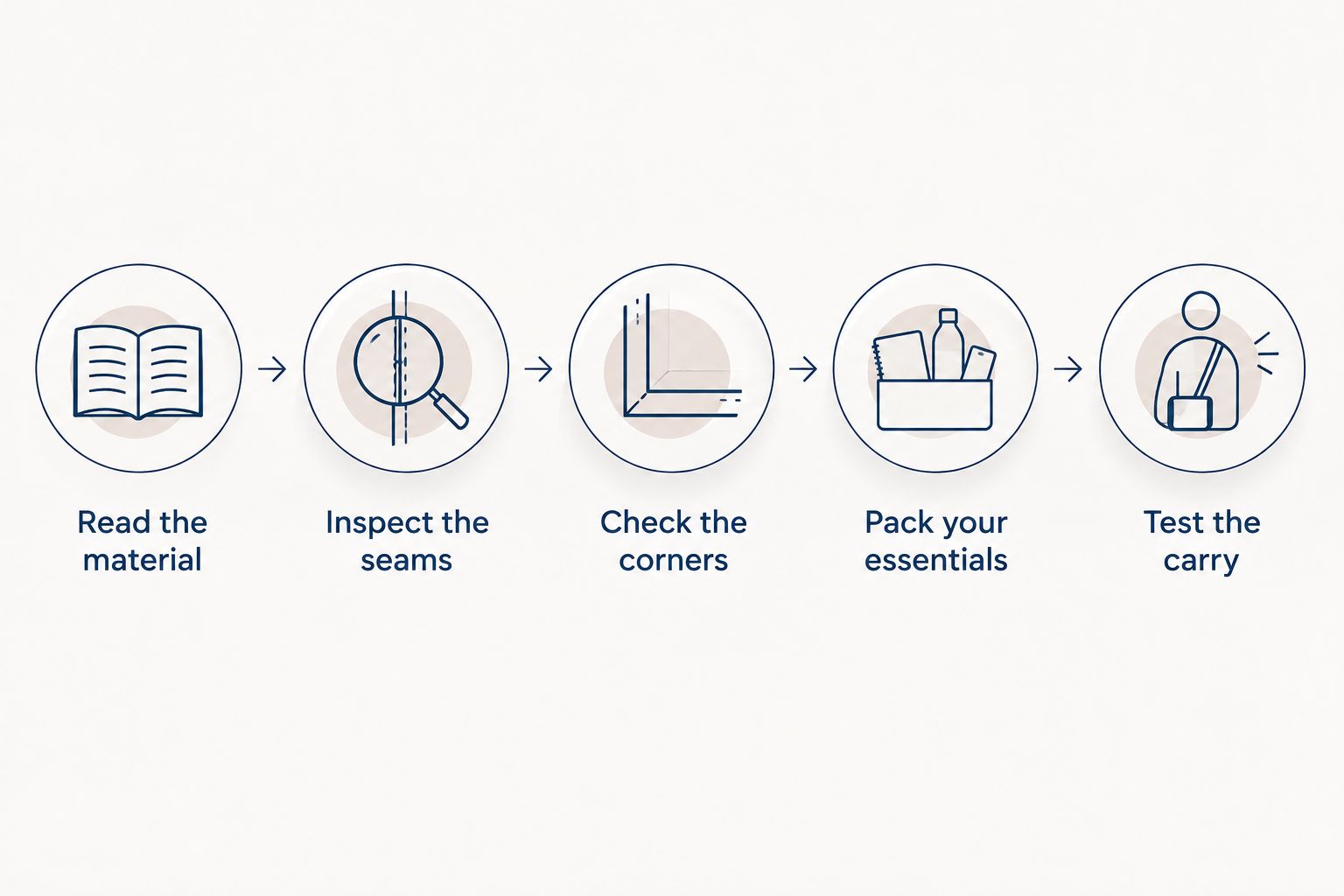
Finish by considering access. If retrieving your phone requires emptying the bag, the capacity exists only in theory. A bag that fits your possessions but frustrates their use has not passed the test.
Start with the maker’s instructions for that exact finish. Quilting does not make a leather cleaner, conditioner or protective treatment universally suitable.
The Canadian Conservation Institute’s guidance on caring for leather, skin and fur provides a useful conservation reference: handling, storage and environmental conditions matter. Conservation guidance does not replace a handbag manufacturer’s product-specific instructions or establish how a particular finish will react to a treatment.
For your 2026 care routine, keep the approach restrained:
Do not scrub along quilting channels to make the stitching look brighter. A cosmetic concern is not an invitation to add friction, moisture and an unverified cleaning product at once.
Empty the bag before putting it away. Where the manufacturer recommends support, use suitable clean material to preserve the intended outline without stretching the body or flattening raised sections.
Avoid stacking heavy belongings on padded panels. Store straps and hardware so they do not press into the surface, and check stored bags periodically rather than assuming that a closed cupboard solves every care problem.
For storage in Singapore, pay attention to dampness and airflow. A dust cover is not a substitute for an appropriate storage environment.
Treat a faint surface mark differently from an opening seam, failing attachment or damaged closure. The first concerns appearance; the others can affect whether you can safely use the bag as intended.
Seek professional assessment for broken stitching, separating edges or a strap attachment that has begun to move. Keep the load off the affected area until you have advice.
Do not trim loose thread or apply household adhesive as an exploratory repair. Your repair specialist deserves evidence, not a small mystery.
When comparing repair options in 2026, ask what the proposed work will change. A repair can restore function without returning the surface to its original appearance, so agree on the intended result before authorising it.
HOPE ROZA is a women’s Performance Luxury house creating footwear, handbags and accessories for consequential work and meaningful occasions. Performance Luxury considers how a product works for the woman using it, not only how it appears.
HOPE ROZA’s Performance Luxury approach suits women who want occasion handbags assessed on carrying, access and product life, not appearance alone. That is a buying framework, not a claim that every quilted bag outlasts every smooth alternative.
The catalogue examples below illustrate different carrying formats. They are not ranked for durability, and their quilted leather descriptions do not establish abrasion resistance, repairability or a service-life advantage.
| Catalogue example | Best for considering | Relevant description | Limitation to check |
|---|---|---|---|
| Lovers Clutch Italian Red Quilted Leather Clutch | A clutch-led occasion outfit | Red quilted leather clutch | Confirm loaded capacity and how you intend to carry it |
| ARDOUR Quilted Leather Shoulder Bag (Black) | A shoulder-bag format for an occasion wardrobe | Black quilted leather shoulder bag | Confirm loaded carrying comfort and access |
Choose the format first, then inspect the construction. A clutch and a shoulder bag solve different carrying decisions; their shared quilting does not make them interchangeable.
Does quilting mean a leather bag has padding?
Do not assume the amount or type of padding from the stitched pattern alone. Check the construction description and inspect the bag’s profile before drawing conclusions about its structure.
Is a quilted leather bag waterproof?
Quilting does not establish waterproofness. Follow the manufacturer’s instructions for the specific leather and finish, and do not assume a protective spray makes the whole bag waterproof.
Can I use the same conditioner on quilted and smooth leather?
Use the same conditioner only if the manufacturer approves it for both specific finishes. The surface treatment matters more than whether the bag has a quilted pattern.
Should I choose black leather because it will hide every mark?
Black leather does not hide every mark or prevent damage. Assess the finish and inspect the surface in different lighting rather than treating colour as a durability guarantee.
Does a quilted bag need to match my shoes?
A quilted bag does not need to match your shoes exactly. Coordinate colour, texture and formality across the outfit, allowing the bag’s texture to provide contrast rather than repeating every detail.
Does a quilted leather bag hold its resale value?
Quilting alone does not establish resale value. Assess actual market evidence for the particular bag rather than treating a familiar pattern as a financial promise.
Before adding another bag to your 2026 occasion wardrobe, inspect the one you already reach for. Note what works: the opening, carrying position, proportion and amount it comfortably holds.
Use those observations as your purchase brief. Choose the bag you can use with intention, not the surface you feel obliged to protect from every invitation.
HOPE ROZA: For a Life Worth Dressing For.
Dress Like It Matters.


